What Incline Should You Use On The Treadmill? Chart By Goal
Alex Chen, Certified Running Coach
2026年8月15日
Short answer: it depends on what you're training, not on the old "always set 1%" rule. For easy runs at conversational pace, 0% is fine. For race-specific workouts faster than about 8:00/mile, 1% better matches outdoor effort. For fat-loss walking, start at 3-5% and build toward 8-12%. And no matter the setting, keep your hands off the rails — gripping them cancels most of the incline's benefit.
Where the 1% rule came from (and who actually needs it)
The 1% recommendation traces back to one specific study: Jones and Doust, published in the Journal of Sports Sciences in 1996. They measured oxygen cost in trained runners and found that a 1% treadmill grade most accurately reproduced the energy cost of outdoor running — because indoors, you're not pushing through air resistance.
Here's the part everyone skips: that finding applied to velocities between 2.92 and 5.0 m/s. That's roughly a 9:10/mile pace on the slow end. At easy jogging speeds, the air resistance you're "missing" indoors is tiny. Jones and Doust's own data showed the oxygen-cost gap at 0% grade was small at slower speeds and only grew meaningful as pace increased.
A 2019 systematic review by Miller and colleagues in Sports Medicine backed this up: across studies, oxygen consumption on a flat treadmill was only about 0.55 ml/kg/min lower than outdoor running. For a recreational runner, that difference is noise.
So the practical translation:
- Easy runs, recovery jogs, base miles: 0% is fine. Set 0.5-1% if it makes you feel honest, but it's optional.
- Tempo runs, intervals, race-pace work (faster than ~8:00/mile): use 1%. This is where the outdoor-indoor gap is big enough to matter for pacing.
- Simulating a hilly race course: program actual grade changes, not a flat 1%.
The incline chart: settings by goal
| Goal | Incline | Speed | Typical cadence | Music BPM |
|---|---|---|---|---|
| Recovery jog / easy run | 0-1% | Conversational | 150-165 SPM | 150-165 |
| Tempo / interval running | 1% | Race-specific | 165-180 SPM | 165-180 |
| Everyday fat-loss walk | 3-5% | 2.8-3.5 mph | 105-120 SPM | 105-120 |
| Glute & hamstring focus | 8-12% | 2.5-3.0 mph | 100-115 SPM | 100-115 |
| 12-3-30 protocol | 12% | 3.0 mph | 100-115 SPM | 100-115 |
| Hill-strength repeats | 6-10% | Hard 60-90s efforts | 160-170 SPM (running) | 160-170 |
Cadence here means steps per minute (SPM), and the BPM column is the music tempo that puts one footstrike on every beat. If you've never counted your steps, our treadmill speed to cadence conversion chart covers how.
What incline actually does to your body
Two things happen when the belt tilts up, and both have been measured directly rather than passed around as gym folklore.
Your energy cost climbs fast. Research on graded walking found metabolic cost rises steeply with grade — one study of 24 participants measured energy expenditure increasing 22.9% at a 10% gradient and 44.2% at 16%, compared with level walking at the same speed. You don't need to walk faster to work harder; you just need the hill.
Your posterior chain wakes up. Franz and Kram's research on graded walking found that at a 9-degree uphill grade, hamstring activation increased several-fold and gluteus maximus contraction more than tripled compared with level walking. This is why incline walking builds the back of your legs in a way flat walking never will, and why it pairs well with treadmill walking for fat loss.
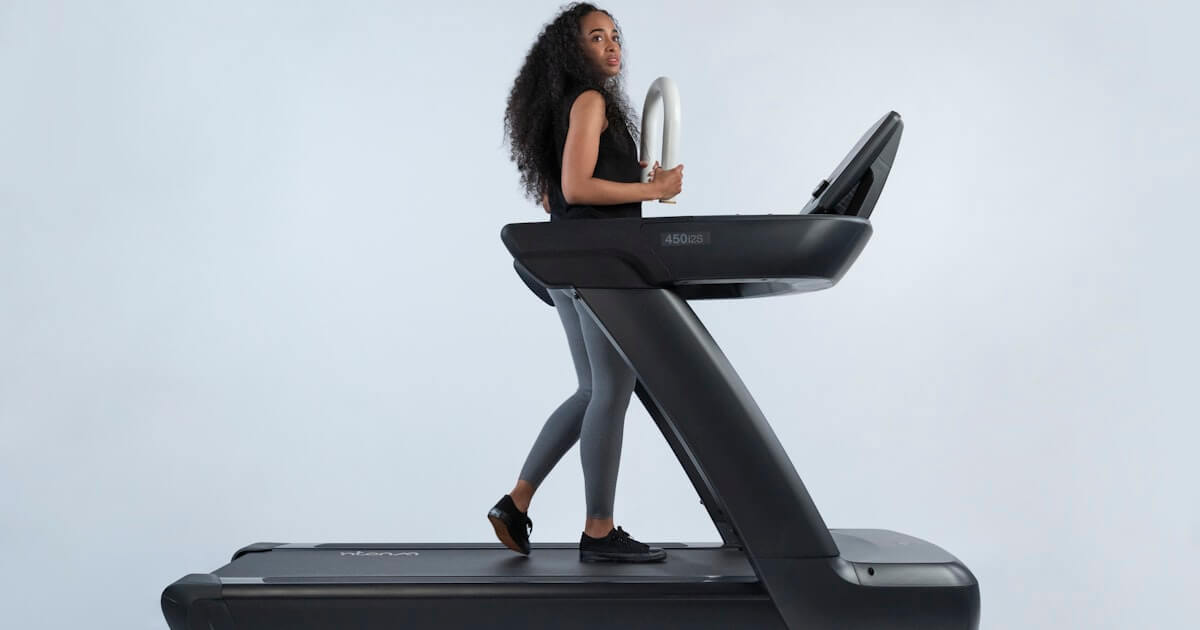
The catch: all of that assumes you're actually carrying your own body weight. Grab the front rail and lean back, and you've turned a 12% hill into a moving sidewalk. Fingertips for balance are fine. Death grip means lower the incline.
How incline changes your cadence (and your playlist)
Here's what most incline guides never mention: when the grade goes up at a fixed speed, your stride shortens and your rhythm changes. Walking at 3.0 mph on a 12% grade, most people settle into 100-115 steps per minute — a much slower physical tempo than flat-ground walking.
That mismatch is exactly why incline sessions fall apart musically. Your usual walking playlist sits around 120-130 BPM, your feet are landing at 105, and every song subtly rushes you. You either speed up and blow past your target heart rate, or you fight the beat for 30 minutes.
Two fixes:
- Match the real tempo. Build a playlist at your actual uphill cadence — usually 100-115 BPM for steep walking. Our 115 BPM incline walking playlist is built for exactly this zone.
- Let an app do the filtering. Finding good songs at 105 BPM is genuinely hard — most workout music lives at 128+. GagaRun scans the playlists you already have and only plays tracks matching your target steps per minute, so a 12% hill session stays locked to your footstrike instead of dragging you off-rhythm.
If you're doing the viral 12% protocol specifically, the full breakdown is in our 12-3-30 treadmill playlist guide.
Mistakes that quietly ruin incline workouts
- Holding the rails. Worth repeating because it's the most common one. Studies of graded walking assume free arm swing; the rails delete the postural work.
- Jumping straight to 12-15%. If you're new, start at 2-3% and add 1-2% per week. Steep grades load the calves and Achilles hard, and going from zero to max is how people end up sore for a week or worse.
- Tiptoe walking. On steep grades, keep the whole foot in contact with the belt. Walking on your toes shifts everything to the calves and shortchanges the glutes you came for.
- Running steep grades for long blocks. Running above ~6% for extended periods is a big Achilles and calf load. Keep steep running to short hill repeats; walk the really steep stuff.
FAQ
Is 15% incline better than 12% for fat loss?
Not automatically. Past the point where you can maintain your speed without grabbing the rails, extra incline stops helping — form breaks down and you offload the work. A 10% grade you can walk hands-free beats a 15% grade you're hanging onto.
Should I use 1% incline for all my treadmill runs?
No. The 1996 research behind the rule applied to paces faster than about 9:10/mile. For easy runs, 0% and 1% are close enough that it comes down to preference. Save the 1% for workouts where you're trying to hit outdoor-equivalent race paces.
What incline is equal to running outside?
At easy paces, 0-0.5% is already close. Around 8:00/mile and faster, 1% is the standard correction. If your outdoor routes are hilly, no single static number replicates them — use a rolling incline program instead.
Does incline walking burn more calories than flat running?
Per minute, usually not — running is more expensive. But steep incline walking gets surprisingly close at a fraction of the joint impact, which is why it works so well as an everyday, repeatable fat-loss session.