Ground Contact Time Balance: Normal Ratios And How To Fix Asymmetry
GagaRun Team
October 30, 2026
You finish a morning run, open your Garmin Connect or running dynamics dashboard, and see Ground Contact Time (GCT) Balance: 48.8% L / 51.2% R. Your initial reaction might be panic: Am I running crooked? Do I have a functional leg length discrepancy? Am I about to injure my right knee? Many runners immediately try to "fix" it on their next workout by consciously stomping or forcefully pushing off with their weaker foot, only to end up with sore calves, an elevated heart rate, and an even worse asymmetry split.
A ground contact time balance split between 49.3% and 50.7% (and even up to 48.0% to 52.0% on typical outdoor pavement) is completely normal biological asymmetry for healthy runners. Perfect 50.0/50.0 symmetry does not exist in human locomotion, and attempting to consciously force equal stance time by pushing harder with one leg disrupts natural muscle-tendon elasticity and significantly increases metabolic energy expenditure. Instead of conscious gait manipulation, the most effective biomechanical solution is increasing your running cadence by 5% to 10% using external auditory rhythm cues. Taking slightly quicker steps naturally shortens stance phase duration, eliminates unilateral overstriding brakes, and centers your footstrike directly beneath your hips.
| Intervention / Cadence Strategy | Cadence Shift | Ground Contact Time (GCT) Impact | Joint Loading & Braking Impulse | Metabolic Economy & Energy Cost | Key Scientific Reference |
|---|---|---|---|---|---|
| Conscious Stance Manipulation (Pushing Harder) | Unchanged (self-selected) | Artificial stance shortening; unequal push-off force | Increases eccentric loading and knee joint absorption on stressed side | Metabolic cost spikes; breaks natural tendon resonance curve ($r^2 = 0.84$) | Moore et al. (2020, PMC7739683, $n=10$) |
| GCT Asymmetry Metabolic Impact | Baseline pace | 1% increase in GCT asymmetry | Uneven impact absorption across left and right lower limbs | Each +1% asymmetry increases metabolic cost by 0.0354 kcal/kg/km (~3.7%) | Beck et al. (2020, PMC7241633, $n=10$) |
| Step Rate Cadence Increase (+5% to +10%) | +5% to +10% (e.g., 162 $\rightarrow$ 170–178 SPM) | Both feet land closer to center of mass; GCT shortens by 10–25 ms | Knee joint energy absorption decreases by 20% to 34%; braking impulse drops | Improves running stiffness without increasing subjective perceived exertion (RPE) | Heiderscheit et al. (2011, PMC3022995, $n=45$) |
| Systematic Review of 51 Running Studies | Step frequency correlates with economy ($r = -0.20$) | Isolated GCT exhibits negligible linear link to economy ($r = -0.02$) | Higher cadence reduces vertical displacement ($r = 0.35$) and elevates leg stiffness | Biomechanical turnover and leg stiffness drive running economy far more than GCT alone | van Oeveren et al. (2024, PMC11127892, $n=1115$) |
What Is Ground Contact Time (GCT) Balance?
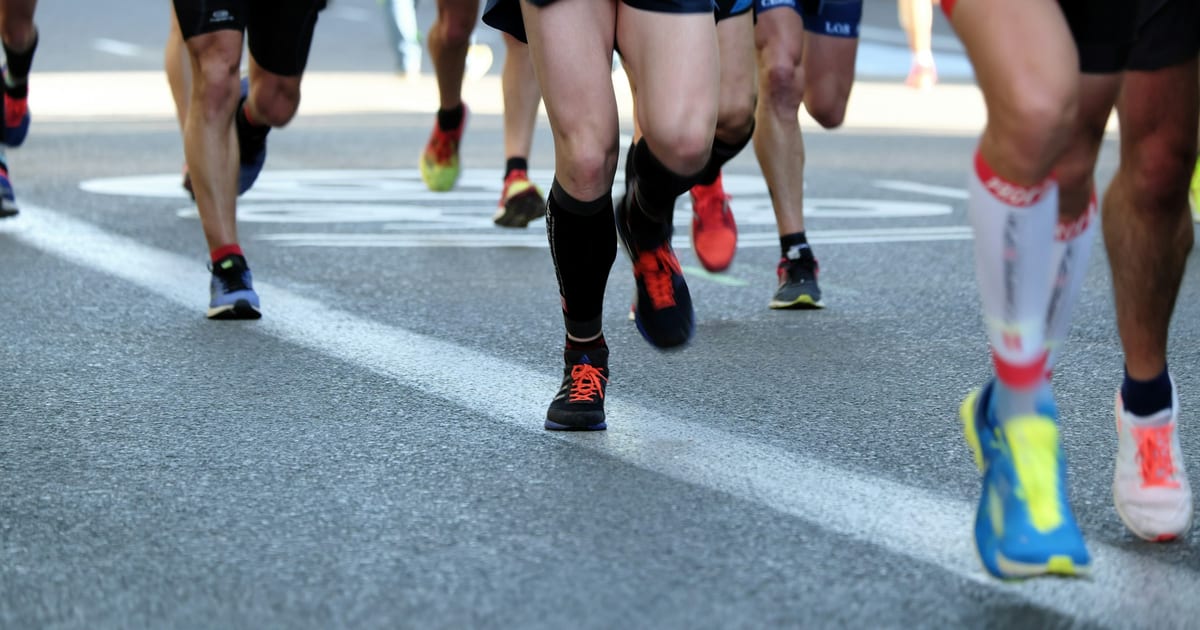
Ground Contact Time (GCT) measures the duration—in milliseconds (ms)—that a single foot remains in contact with the ground during the stance phase, spanning initial touchdown, midstance loading, and terminal toe-off. Most recreational runners at training paces between 5:00/km and 6:30/km (8:00 to 10:30 min/mile) record total ground contact times ranging from 230 ms to 285 ms.
Ground Contact Time Balance divides that stance duration between your left and right legs as a percentage of your total running cycle. If your left foot averages 245 ms on the pavement while your right foot spends 255 ms, your split is approximately 49.0% Left / 51.0% Right.
Garmin Running Dynamics Color Zones
Garmin running dynamics pods and chest straps (such as the HRM-Pro) categorize GCT Balance into standard color-coded zones:
- Green Zone (49.3% to 50.7%): Symmetric balance. Typical for the vast majority of experienced runners on flat, uniform terrain.
- Orange Zone (48.0%–49.2% L or 50.8%–52.0% R): Mild asymmetry. Very common when navigating crowned roads, mild head/crosswinds, slight muscular dominance, or long-run neuromuscular fatigue.
- Red Zone (<48.0% L or >52.0% R): Noticeable asymmetry. Usually indicates previous lower-limb injury guarding, structural imbalance, extreme road camber, or significant overstriding on one side.
Why 50.0/50.0 Symmetry Is a Myth
Many runners treat 50.0% Left / 50.0% Right as the holy grail of running mechanics. Biomechanical research consistently reveals that human running is inherently asymmetrical:
- Natural Biological Asymmetry: A study published by Folland and colleagues (2017, PMC5473370) evaluating biomechanical factors in trained distance runners demonstrated that minor functional asymmetries in force production and ground contact are ubiquitous. Right-handed individuals frequently exhibit subtle left-hip or right-ankle stability differences that produce 0.5% to 1.5% deviations without any pathology.
- The Paradox of Conscious Gait Forcing: Moore et al. (2020, PMC7739683) investigated runners manipulating their ground contact time. They discovered that a runner's freely chosen contact duration sits within 5% of their mathematical metabolic optimum. When runners consciously attempt to "yank" their foot off the ground faster or push harder with the opposite leg, they disrupt the natural elastic recoil of the Achilles tendon, driving up oxygen consumption and heart rate.
- The True Cost of Excessive Asymmetry: While mild asymmetry is harmless, pronounced asymmetry carries an energetic penalty. Controlled laboratory research by Beck et al. in Frontiers in Sports and Active Living (2020, PMC7241633) demonstrated that each 1% increase in ground contact time asymmetry increases metabolic energy expenditure by 0.0354 kcal per kilogram per kilometer (approximately a 3.7% jump in metabolic cost). Asymmetry accounted for over 65% of the variance in running economy ($R^2 = 0.65$).
The takeaway is straightforward: Do not try to fix GCT balance by thinking about your feet while running. You cannot voluntarily control a 250-millisecond ground impact phase with conscious thought. Instead, change the global step rhythm.
The Biomechanical Root of Asymmetry: Overstriding and Braking Force
Why does one foot stay on the ground longer than the other in the first place? In more than 80% of uninjured runners, ground contact asymmetry is caused by unilateral overstriding:
- The Braking Leg: When a runner has slight pelvis tilt or unilateral hip tightness, their dominant leg often reaches out farther ahead of their center of mass. As explained in our guide on how to stop overstriding, landing with the heel or foot far in front of the knee creates an immediate horizontal braking force.
- Prolonged Ground Time: That braking force halts forward momentum. The runner must wait for their center of gravity to travel over the planted foot before they can roll into toe-off. This turns a swift, bouncy step into a prolonged 270–290 ms collision.
- The Escaping Leg: In contrast, the less dominant or tighter side may take a shorter, defensive step, spending only 240 ms on the ground. The result is a skewed 47.5% / 52.5% reading on your watch.
When you learn how to reduce ground contact time and how to reduce vertical oscillation, you eliminate that braking phase across both legs simultaneously.
The Solution: A 5% Cadence Increase with Auditory Rhythm
The most effective, scientifically backed method to balance ground contact time is increasing your baseline step cadence by 5% to 10%.
In a landmark biomechanical trial led by Heiderscheit and colleagues at the University of Wisconsin-Madison (2011, PMC3022995, $n=45$), increasing running cadence by just 5% above a runner's preferred baseline produced significant mechanical shifts without altering forward speed:
- Footstrike position moved substantially closer to the body's center of mass.
- Horizontal braking impulse dropped significantly.
- Ground contact time naturally decreased by 10 to 25 milliseconds.
- Mechanical energy absorption at the knee joint decreased by 20% to 34%.
Low Cadence (156 SPM)  --> Reaching Foot --> Heavy Braking Phase --> 275 ms GCT --> Asymmetry Amplified
                                   ↓ (+5% to +10% Cadence Shift)
Optimal Cadence (168 SPM) --> Under-Hip Landing --> Elastic Recoil --> 240 ms GCT --> Balanced L/R Turnover
Auditory Rhythm Entrainment: Letting Beats Balance Your Stride
The nervous system naturally synchronizes bilateral motor output when guided by an external auditory pulse—a phenomenon known in motor control as auditory-motor entrainment.
When you listen to a steady, rhythmic metronome beat or music matched precisely to your target step frequency (such as 168 or 172 BPM), your brain stops micromanaging individual limb forces. Both feet subconsciously synchronize with the predictable rhythm, naturally leveling out stance durations.
In GagaRun (iOS version 1.54+), runners can select a personalized target cadence (such as a 5% bump from 162 to 170 SPM), automatically analyze song tempos across their personal Apple Music library, and aggregate matching tracks into an uninterrupted running playlist. The app also features a dedicated running metronome mode for workouts where you prefer pure acoustic tempo clicks. (Note: GagaRun is an audio BPM tempo filtering and metronome tool; it does not measure real-time foot strikes, ground contact balance, or provide medical gait diagnostics).
4-Week Ground Contact Time Balance Optimization Plan
Follow this progressive 4-week protocol to smooth out stance asymmetry without overloading your calves or driving up heart rate:
┌──────────────────────────────────────────────────────────────────────────────┐
│                  4-WEEK GROUND CONTACT TIME BALANCE PROTOCOL                  │
├──────────┬──────────────────────┬────────────────────────────────────────────┤
│ Week 1   │ Baseline Audit       │ 3 easy runs on flat, crown-free pavement.   │
│          │                      │ Log average GCT and L/R balance percentage. │
├──────────┼──────────────────────┼────────────────────────────────────────────┤
│ Week 2   │ +5% Cadence Cue      │ Bump cadence by 5% (e.g., 160 → 168 BPM).  │
│          │                      │ Run with matched-BPM music for 20 minutes. │
├──────────┼──────────────────────┼────────────────────────────────────────────┤
│ Week 3   │ Unilateral Strength  │ Add single-leg deadlifts, Bulgarian split  │
│          │                      │ squats, and single-leg calf raises (2x/wk).│
├──────────┼──────────────────────┼────────────────────────────────────────────┤
│ Week 4   │ Fatigue Retention    │ On long runs, hold cadence steady during   │
│          │                      │ final 25% of mileage to prevent drop-off.  │
└──────────┴──────────────────────┴────────────────────────────────────────────┘
- Week 1 (Baseline Audit): Complete three easy workouts on a flat, non-cambered surface (or a flat treadmill). Record your average cadence, average GCT, and L/R balance. If your initial heart rate feels slightly elevated when first adjusting your rhythm, review our guide on does increasing cadence increase heart rate to understand normal neuromuscular adaptation.
- Week 2 (+5% Cadence Introduction): Calculate your target cadence by multiplying your baseline by 1.05 (for example, $160 \times 1.05 = 168\text{ SPM}$). Load a playlist of 168 BPM songs in GagaRun. Focus on stepping lightly to the beat, imagining the road as a hot surface where you lift your feet rather than stomp them down.
- Week 3 (Unilateral Strength & Stability): Muscular imbalances between the left and right hips (especially gluteus medius weakness) often cause one hip to drop during stance phase. Perform 3 sets of 8–10 repetitions of single-leg Romanian deadlifts, step-ups, and single-leg calf raises twice per week to build symmetrical supporting strength.
- Week 4 (Fatigue Resistance on Long Runs): As fatigue sets in during the final 5 kilometers of a long run, ground contact time naturally increases and asymmetry tends to widen, as detailed in our analysis on why cadence drops on long runs. Use an audio metronome or high-energy BPM playlist to hold your step turnover steady through the closing miles.
Frequently Asked Questions (FAQ)
Does running on a cambered road or running track skew my GCT balance?
Yes, significantly. Most paved roads are engineered with a crown—a subtle downward slope toward the curb to facilitate rainwater drainage. When running on the left side facing traffic, your left foot lands slightly lower than your right foot, absorbing more impact and prolonging left-side ground contact time by 1% to 3%. Similarly, running exclusively in one direction around a 400-meter track keeps your inside (left) leg in prolonged stance phase. To test your true biological balance, run on a flat treadmill or switch sides on safe, flat pathways.
Can carbon-plated super shoes affect my ground contact time balance?
Yes. Carbon-fiber plates and ultra-resilient PEBA foams are engineered to compress and snap back under high load. If you run at an easy pace (slower than 5:30/km) where you cannot fully compress the rigid plate, or if one foot pronates slightly more than the other, the stiff longitudinal plate can delay toe-off on your weaker side, artificially skewing GCT balance by 1.5% to 2.5%. Reserve carbon racers for tempo workouts and race days, and perform daily easy runs in traditional daily trainers.
When does ground contact time balance require clinical attention?
If your balance consistently records worse than 46.0% / 54.0% across multiple flat runs, or if your split suddenly shifts by more than 3% following an acute ache or twinge, this is a strong indicator of pain-avoidance gait compensation (antalgic gait). If the asymmetry is accompanied by localized knee, hip, or Achilles tendon pain, consult a physical therapist or sports medicine specialist rather than attempting to self-correct with cadence training.