Sled Push Workout BPM: Lock Your Prowler Pace With Music
Alex Chen, Certified Running Coach
2026年7月2日
Sled Push Workout BPM: Lock Your Prowler Pace With Music
Short answer: For race-weight prowler pushes (HYROX, heavy conditioning), lock music to 80–100 BPM with one short step per beat. For lighter speed work (60–70% load), use 110–120 BPM. Sprinting the first 15 meters at 140+ BPM cadence is the fastest way to stall the sled by meter 25.
I've watched this at every local HYROX I've attended. Athlete explodes off the line, sled stops dead, they stand upright gasping for 20 seconds, then repeat. Total time: 2:45. The athlete next to them never broke rhythm at 90 BPM and finished in 1:55.
What a prowler sled push actually demands
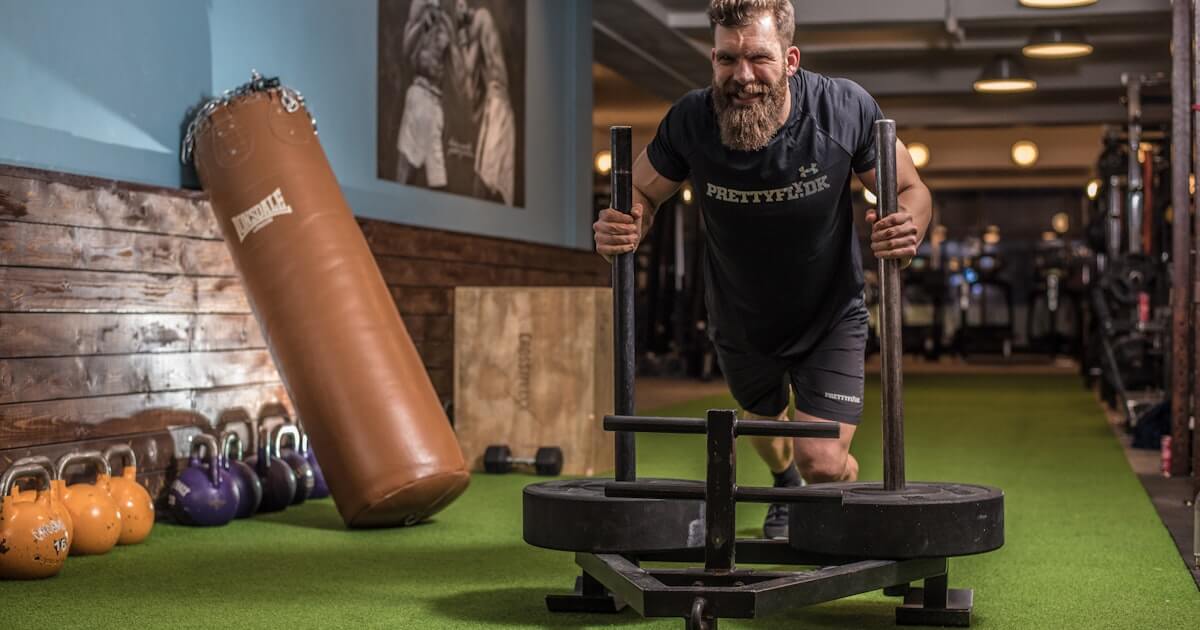
A prowler sled push is horizontal force production under load. You grip low handles, lean forward at roughly 45 degrees, keep your arms straight as rigid levers, and drive short, punchy steps through your toes. The sled doesn't care about your 5K PR. It cares about continuous horizontal force — the moment your stride gets long or your torso rises, momentum dies.
Unlike running (where elite athletes sit at 170–185 steps per minute), sled pushing rewards a deliberately slow turnover. HYROX coaches consistently prescribe 80–100 steps per minute — roughly half your natural running cadence — with foot contact directly beneath or slightly behind your center of mass.
The science: why cadence controls sled speed
A 2022 study in the European Journal of Sport & Exercise Science tested sled pushes at three metronome-locked cadences: 80, 110, and 140 steps per minute over 40 feet with constant resistance. Faster cadence produced quicker lower-limb muscle activation and shorter push duration — but only when the athlete could maintain form. The key variable wasn't raw speed; it was controlled, consistent turnover without a braking phase on each stride.
ACE's battle rope research found a similar pattern in upper-body HIIT: athletes told to go "as hard as possible" without a pacing cue lose output by the second half of every interval. Sled pushes follow the same law — external rhythm beats willpower.
Real HYROX data from 82,000+ athlete results puts the median sled push time at roughly 2:52 for Open Men and 2:44 for Open Women over 50 meters (152 kg / 102 kg race weight). Athletes who negative-split the push — consistent speed across both 25-meter halves — typically save 10–20 seconds versus the start-stop sprinters.
How to calculate your sled push music BPM
Sled push pacing uses a 1:1 ratio: one foot strike = one musical beat.
Step 1: Count your sustainable step rate. Load the sled to 70% of your target weight. Push 25 meters at a pace you could repeat six times with 90 seconds rest. Count steps for the full distance.
Step 2: Convert to steps per minute. If 25 meters took 40 steps in 28 seconds, that's 40 ÷ (28/60) = 86 steps/min → lock 86 BPM.
Step 3: Start 5% below your practice lock for race day. Practice at 90 BPM? Race target is 85–88 BPM. Controlled beats fast.
| Load context | Target steps/min | Direct-sync BPM | Double-time music BPM | Best for |
|---|---|---|---|---|
| HYROX race weight (50m) | 80–95 | 80–95 BPM | 160–190 BPM | Race simulation |
| Heavy strength (110–120% load) | 70–85 | 70–85 BPM | 140–170 BPM | Max force development |
| Speed work (60–70% load) | 100–120 | 100–120 BPM | 200–240 BPM | Acceleration from dead stop |
| Warm-up / technique (empty–40%) | 90–110 | 90–110 BPM | 180–220 BPM | Motor pattern drilling |
| Post-run brick (fatigued legs) | 75–90 | 75–90 BPM | 150–180 BPM | HYROX Run 2 → sled sequence |
Few songs sit at exactly 87 BPM with enough drive for a prowler session. Use double-time mapping: play 174 BPM hip-hop but take one step every two beats. Same physical timing, ten times the playlist options.
This half-time trick is the same logic behind StairMaster BPM matching — slow movement, fast music, locked rhythm.
Two music strategies (pick one per session)
Strategy A: Step lock (race simulation)
Best for HYROX prep, heavy 50-meter pushes, and any session where zero stalls matter more than peak speed.
- Set one step per beat at 85–90 BPM for your first race-weight session.
- Drive on the downbeat (kick drum). Recovery foot on the backbeat.
- If the sled stops before 25 meters, drop 5 BPM next set — not "try harder."
Repz HYROX coaching data shows the most common failure mode is sprint cadence in the first 20 meters that creates lactate debt you can't repay mid-station. A controlled 85% effort with locked BPM beats a 100% sprint with three stops every time.
Strategy B: High-BPM energy with internal step count (speed work)
Best for light-load acceleration drills and 15–25 meter repeat sprints.
- Play 140–160 BPM music for arousal.
- Internally count one step every two beats (70–80 effective BPM).
- Rest walks between sets: 90 BPM tracks — same work/rest contrast as HIIT treadmill protocols.
Karageorghis's meta-analysis (Psychological Bulletin, 2020) found tempo-matched music reduced RPE by roughly 12%. On a 50-meter push where your quads are already cooked from a 1 km run, that 12% matters.
Three sled push workouts with exact BPM plans
Workout 1: HYROX race simulation (intermediate)
Mirrors the race sequence: Run 1 km → 50m sled push at race weight.
- Run 1 km at HYROX target pace using your 8-run BPM plan.
- Immediately push 50m at race weight with 88 BPM lock. No rest between run and push.
- Rest 3 minutes. Repeat 3–4 rounds.
- Score: total push time + run time. Track whether your second 25m split matches your first.
Target: Open Men sub-2:00 push off a race-pace km; Open Women sub-1:45.
Workout 2: Speed + strength split (advanced)
Weekly double session — one speed day, one strength day.
Speed day (Tuesday):
- 6 × 25m at 60% race weight, 115 BPM lock.
- Rest 90 seconds. Goal: every 25m under 10 seconds.
Strength day (Friday):
- 5 × 15m at 120% race weight, 78 BPM lock.
- Rest 2–3 minutes. Goal: no stalls, consistent body angle.
Pair with battle rope finishers on separate days — stacking prowler and ropes in one session destroys grip and quad output for both.
Workout 3: Triathlon-style brick (advanced)
For athletes cross-training with triathlon brick sessions:
- Bike or row 5 minutes at threshold (use your rowing BPM guide for erg pacing).
- Run 800m at 160 SPM / ~160 BPM.
- Push sled 50m at race weight, 85 BPM lock.
- Repeat 2 rounds. Rest 4 minutes between rounds.
This teaches your legs to find short, punchy turnover when they're already glycogen-depleted — the exact HYROX race condition.
Lock the tempo before you touch the handles
Searching for 88 BPM tracks while the race clock runs is how stalls happen. GagaRun filters your library to a target band — say 85–92 — so every song supports your step lock without touching your phone at the sled station. Set it during your run approach. Let the beat carry you through all 50 meters.

FAQ
What BPM should I use for a HYROX sled push?
Most Open division athletes perform best at 80–95 BPM with one step per beat at race weight (152 kg men / 102 kg women). Beginners often go too slow (walking cadence, 60–70 BPM) and waste 60+ seconds. Advanced athletes pushing lighter loads for speed work can reach 110–120 BPM.
Why does my sled keep stopping mid-push?
Two causes, almost always together: stride too long (creates a braking phase each step) and body angle rising under fatigue (you stand up, lose leverage, force vector goes vertical instead of horizontal). Fix both with shorter steps at 85–90 BPM and a locked 45-degree lean. If you need a breather, limit pauses to 5 seconds at the 15m and 30m marks — not 20-second stand-up rests.
Can I use my running playlist for sled pushes?
No. Running cadence (150–175 steps per minute) is roughly double the optimal sled push turnover. A 170 BPM running playlist encourages long strides and sprint starts that stall the sled. Use the load-specific table above, or halve your running BPM and treat every other beat as a step.
How does sled push BPM differ from battle rope BPM?
Battle ropes are upper-body dominant with wave rates of 100–120 per minute (one arm strike per beat). Sled pushes are lower-body horizontal force with step rates of 80–100 per minute — slower turnover, same 1:1 beat mapping. See our battle rope BPM guide for upper-body HIIT pacing.
How often should I train sled push cadence?
2–3 sessions per week during a 12–16 week HYROX build, alternating speed work (lighter load, higher BPM) and race simulation (race weight, 85–90 BPM). At least one session per week should include a prior run or erg effort so you practice turnover under fatigue, not just from fresh legs.