Battle Rope Workout BPM: Lock Your Wave Pace With Music
Sarah Jenkins, Fitness Physiologist
2026年7月2日
Battle Rope Workout BPM: Lock Your Wave Pace With Music
Short answer: For alternating arm waves, lock music to 100–120 BPM with one wave per beat. For double-arm power slams, use 50–60 BPM (one slam every two beats). For short HIIT rounds, play 140–160 BPM for energy but count waves to the slower internal rhythm so round 8 looks like round 1.
I've watched this wreck more finisher sets than bad grip ever has. Athlete opens a 30-second wave interval at 150 waves per minute, then the rope goes slack by second 20. The playlist wasn't wrong. The pacing was.
What battle rope training actually demands
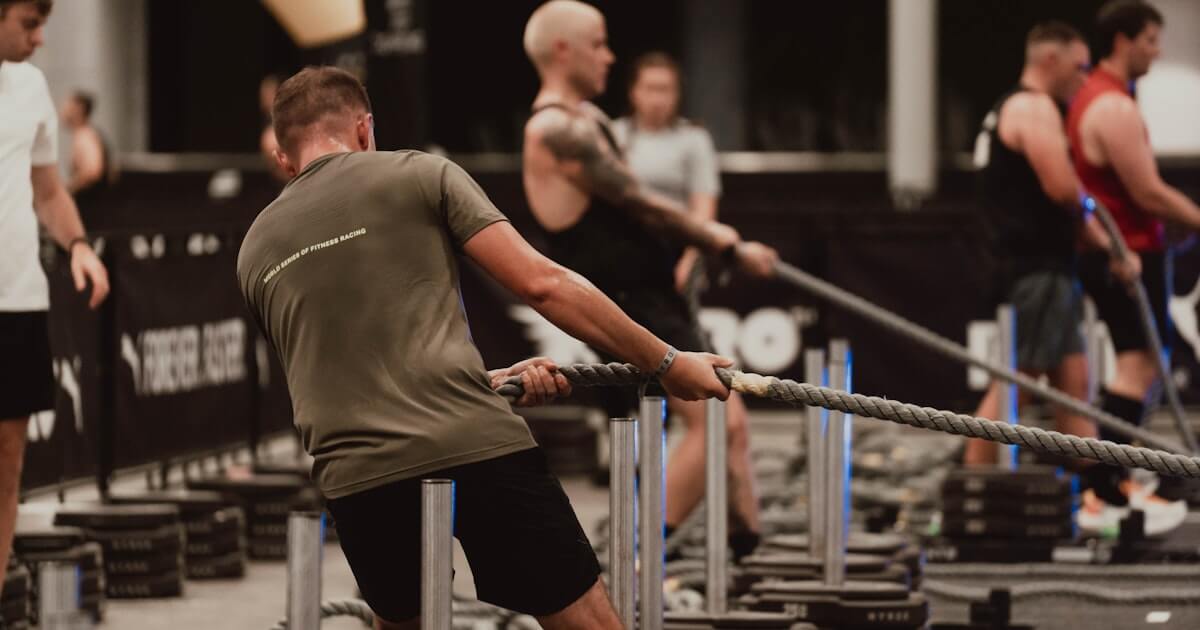
A battle rope workout is upper-body HIIT disguised as arm day. You anchor a 30–50 foot rope at its midpoint, grab one end in each hand, and generate continuous waves — alternating, simultaneous, slams, snakes, or circles — while staying in an athletic stance with soft knees and a braced core.
Unlike running, there's no universal "steps per minute" everyone should hit. Wave rate depends on rope diameter, wave type, and whether you're chasing power or endurance. What is universal: the first 10 seconds of every interval should look identical to the last 10 seconds. Music tempo is how you enforce that when your shoulders start screaming.
The science: why wave rate matters more than "going hard"
ACE-sponsored research tested a 14-minute battle rope HIIT session — 15 seconds of work, 45 seconds of active rest, seven wave variations performed twice (ACE Certified, 2020; published in International Journal of Research in Exercise Physiology).
The numbers:
| Metric | Average result |
|---|---|
| Energy expenditure | 10.1 kcal/min (~141 kcal total) |
| Heart rate | 148 bpm (79% HRmax) |
| VO₂ | 26.9 ml/kg/min (51% VO₂max) |
| RPE | 14.2 (peaked at 16.3) |
That's vigorous-intensity cardio — enough to improve cardiorespiratory fitness per ACSM guidelines. Double-arm power slams produced the highest physiological spike in the session.
Here's the catch: participants were told to work "as fast and as hard as possible" during each 15-second burst. No prescribed wave count. That's fine for a lab study. In a real gym, "as hard as possible" on rep 1 becomes "barely moving the rope" on rep 7 of a circuit.
Coach Justin Thomas Miller, who trains athletes on battle ropes, recommends 120–150 alternating waves per minute once technique is solid. Beginners should aim lower — 100–120 waves per minute — until waves travel cleanly from handle to anchor without dying halfway down the rope.
How to calculate your battle rope music BPM
Battle rope pacing uses a 1:1 ratio for alternating waves (one arm strike = one beat) and a 1:2 ratio for double-arm movements (one full slam cycle = two beats).
Step 1: Count your sustainable wave rate. Set a 20-second timer. Perform alternating waves at a pace you could hold for 3 minutes. Count total waves. Multiply by 3 for waves per minute.
Step 2: Match BPM directly. If you hit 36 waves in 20 seconds, that's 108 waves/min → lock 108 BPM music.
Step 3: Subtract 5–10% for interval work. Practice lock at 110 BPM? Race-day target is 100–105 BPM. Slow feels wrong. Slow finishes.
Battle rope BPM reference table
| Wave type | Target waves/min | Direct-sync BPM | Half-time music BPM | Best for |
|---|---|---|---|---|
| Alternating waves (beginner) | 80–100 | 80–100 BPM | 160–200 BPM | Learning technique |
| Alternating waves (standard) | 100–120 | 100–120 BPM | 200–240 BPM | 30–60 sec intervals |
| Alternating waves (advanced) | 120–150 | 120–150 BPM | 240–300 BPM | Power endurance |
| Double-arm waves | 50–70 | 50–70 BPM | 100–140 BPM | Steady conditioning |
| Double-arm power slams | 25–35 | 50–70 BPM (2-beat cycle) | 100–140 BPM | Max power intervals |
| In-and-out / snake waves | 60–80 | 60–80 BPM | 120–160 BPM | Core + shoulder endurance |
| Arm circles (in/out) | 40–60 | 40–60 BPM | 80–120 BPM | Shoulder mobility finisher |
Few songs sit at exactly 108 BPM with enough energy for a gym session. That's where half-time mapping saves you: play 216 BPM EDM but strike one wave every two beats. Same physical timing, bigger playlist pool.
This is the same logic behind kettlebell swing BPM matching — slow movement, fast music, half-time lock.
Two music strategies (pick one per workout)
Strategy A: Wave lock (volume intervals)
Best for 30–60 second work intervals, EMOMs, and circuit finishers where consistent wave amplitude decides your output.
- Set alternating waves to one strike per beat at 100–110 BPM for your first session.
- Listen for the downbeat (usually the kick drum). Right hand strikes on beat 1, left on beat 2.
- If waves stop reaching the anchor by second 20, drop 5 BPM next round — not "try harder."
Karageorghis and colleagues found that synchronous music during circuit exercise improved rep output for women and matched metronome pacing for men (Psychology of Sport and Exercise, 2010). Battle ropes sit in that same zone: a steady external beat often beats random shuffle hype.
Strategy B: High-BPM energy with internal wave count (Tabata)
Best for 15–20 second ACE-style bursts and Tabata finishers after your main lift or run.
- Play 150–165 BPM music for arousal.
- Internally count one wave every two beats (75–82 effective BPM).
- Rest intervals: switch to 90–100 BPM tracks — same contrast logic as HIIT treadmill sprint protocols, which use 160–180 BPM work and 100–110 BPM recovery.
Terry's meta-analysis of 139 studies in Psychological Bulletin (2020) found music reliably lowers perceived exertion and improves physical performance, with fast-tempo tracks working best. You won't magically wave longer in a 15-second burst — but lower perceived effort at the same wave rate is real when your shoulders are on fire.
Three battle rope workouts with exact BPM plans
Workout 1: ACE 14-minute protocol (beginner)
Mirrors the research protocol — honest baseline for calorie burn and intensity.
- Warm up 5 minutes on an assault bike or jumping jacks to 110 BPM music.
- Work intervals: 15 seconds on, 45 seconds active rest. Rotate: alternating waves → double-arm waves → power slams → in-and-out → snake → inward circles → outward circles. Two rounds total.
- Lock alternating waves at 100 BPM during work intervals. Power slams: 55 BPM (slam on beat 1, reset on beat 2).
- Cool down 5 minutes easy bike or walk at 90 BPM.
Expected burn: roughly 140 kcal in 14 minutes of rope work, plus warm-up/cool-down.
Workout 2: 10-minute AMRAP circuit (intermediate)
30 sec alternating waves → 10 sec rest → 30 sec double-arm slams → 10 sec rest → 15 bodyweight squats. Repeat until 10 minutes expire.
- Alternating waves: 110 BPM lock.
- Double-arm slams: 55 BPM (2-beat cycle).
- Rest periods: sway side-to-side — active recovery, not collapsing.
- Score = total rounds. Next session, add 5 BPM only if your round count increases.
Pair this on separate days with burpee AMRAP pacing — don't stack both in one session until your wave lock is automatic.
Workout 3: HYROX-style station prep (advanced)
Simulates the rope station in functional fitness races:
- 400m run at race pace (use your HYROX run BPM plan).
- 30 seconds max alternating waves at 120 BPM lock.
- 30 seconds double-arm slams at 60 BPM.
- Repeat 3–5 rounds. Rest 2 minutes between rounds.
The run-to-rope transition is where pacing dies. Set your rope BPM before the run starts. Switch playlists at the station — run lock and wave lock are separate contracts.
Lock the tempo before the clock starts
Digging for 108 BPM tracks mid-circuit is how rhythm dies. GagaRun filters your library to a target band — say 105–115 — so every song supports your wave lock without touching your phone between intervals. Set it once before the timer starts. Let the beat do what your shoulders won't.

FAQ
What BPM should I use for battle rope alternating waves?
Most trained athletes land between 100 and 120 BPM with a 1:1 wave-to-beat ratio. Beginners should start at 90–100 BPM until waves travel cleanly to the anchor. Advanced athletes pushing power endurance can work up to 130–150 BPM, but only after 4–6 sessions at the lower lock.
Is a metronome better than music for battle ropes?
For short max-effort bursts, probably not — you want the arousal boost from music. For 30–60 second intervals where wave amplitude matters more than peak speed, a steady beat (metronome or BPM-locked playlist) prevents the classic "fast start, dead finish" pattern. Test both across three sessions and log your average waves per interval.
Can I use running BPM guides for battle ropes?
No. Running cadence (150–175 steps per minute) maps to footstrike frequency, not upper-body wave generation. A 170 BPM running playlist won't pace 170 alternating waves per minute — that's unsustainable for your shoulders and grip. Use the wave-type table above.
How many calories does a battle rope workout burn?
ACE's 14-minute HIIT protocol averaged 10.1 kcal/min (~141 kcal total) in young male participants. A 30-minute session at similar intensity would land around 300 kcal, depending on body weight, rope thickness, and wave amplitude. Thicker ropes (2-inch diameter) and longer ropes (50 feet) increase energy cost.
What music genre works best for battle rope training?
Electronic, hip-hop, and pop with clear downbeats work best — same reason they dominate rowing machine BPM guides. Predictable kick drums make timing your catch (the moment your hand drives down) effortless. Avoid tracks with tempo changes mid-song during locked intervals.