Stair Climbing Workout: Cadence, BPM, And A Real Stairs Plan
Sarah Jenkins, Fitness & Lifestyle Blogger
2026年8月25日
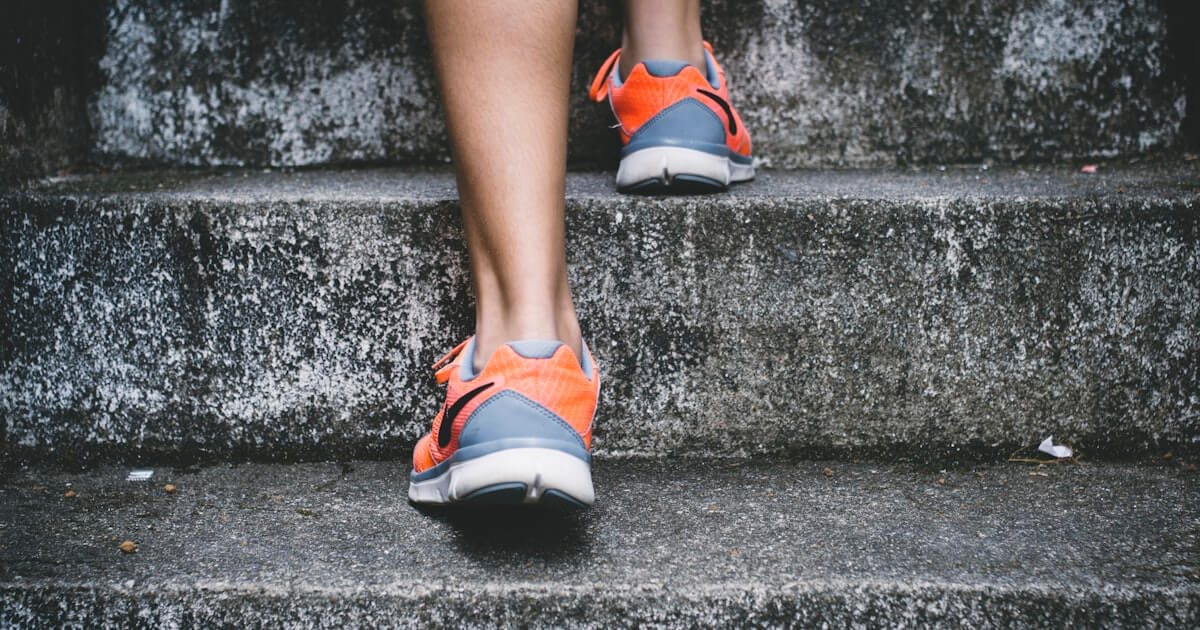
Climbing real stairs burns roughly 8 to 11 calories per minute, which puts it in vigorous-intensity territory at about 8.6 METs. For a steady fat-burning session, hold 60 to 75 steps per minute and pace yourself with 120-150 BPM music using the half-time trick: one step for every two beats. No gym membership required. You need a stairwell, a playlist, and about 20 minutes.
I started taking stairs seriously during a month when my gym was closed for renovation. My building has 11 floors. That stairwell turned out to be a better cardio machine than the one I'd been paying for.
Why real stairs punch above their weight
The numbers on stair climbing are honestly a little absurd for something this boring-sounding.
Classic energy-cost research places stair ascent at around 8.6 METs, with a 2012 study estimating 8.5 to 9.2 calories burned per minute depending on whether you take one or two steps at a time. That's vigorous-intensity work, roughly double the oxygen demand of brisk walking. A 30-minute session lands somewhere between 255 and 300 calories for most people.
The long-term data is stronger. A 2024 meta-analysis presented at the European Society of Cardiology congress (Paddock et al., pooling 480,479 participants) found that regular stair climbers had a 24% lower risk of all-cause mortality and a 39% lower risk of dying from cardiovascular disease compared to non-climbers.
And you don't need much. In an eight-week workplace study published in the Journal of Sports Science and Medicine (Boreham et al.), office workers who climbed a 145-step staircase a few times a day at 75 steps per minute improved their predicted VO2 max by 9.4%. Total exercise time: under 30 minutes per week.
The cadence question nobody answers
Here's where most stair advice falls apart. People tell you to "climb stairs for exercise" but never tell you how fast. So you either sprint up two floors, gas out, and quit, or you plod so slowly it's basically standing.
Your stepping rate is the dial that controls everything:
| Effort level | Steps per minute | What it's for |
|---|---|---|
| Easy / recovery | 40-55 SPM | Warm-up, active recovery, total beginners |
| Steady fat-burn | 60-75 SPM | Zone 2-3 work, 20-30 min sessions |
| Vigorous | 80-100 SPM | Intervals, VO2 max "exercise snacks" |
| Sprint | 100+ SPM | Stadium repeats, short bursts only |
That 75 SPM figure isn't arbitrary. It's the exact cadence used in the Boreham workplace study that produced the 9.4% VO2 max gain: brisk enough to elevate your heart rate within one flight, sustainable enough that you're not clinging to the handrail by floor four.
Wait, so how do you actually hold 75 steps per minute without staring at a metronome app? Music.
The half-time music trick
Try finding a workout playlist at 70 BPM. It's all sad acoustic ballads. Not what you want echoing through a concrete stairwell.
The fix is the same half-time method that works on the StairMaster: pick songs at double your target cadence and step on every other beat.
- Target 60 SPM → play 120 BPM tracks
- Target 70 SPM → play 140 BPM tracks
- Target 75 SPM → play 150 BPM tracks
At 140-150 BPM you're in the sweet spot of modern pop, house, and hip-hop, so there's no shortage of material. Your foot lands on every second kick drum, and the climb turns into something closer to a rhythm game than a chore.
Manually building a playlist where every track sits at exactly 140 BPM is the tedious part. This is what I use GagaRun for. It connects to your existing Apple Music or Spotify library, you set the target BPM, and it only plays songs matching that tempo. Set it to 140, step on the half-beat, and your cadence locks itself in without you thinking about it.
Three workouts, from beginner to brutal
1. The steady climber (beginner, 15-20 min)
Find a stairwell with at least 3-4 flights. Climb at 60-65 SPM (120-130 BPM music, half-time), take the elevator or walk down slowly, repeat. Descending stairs loads your knees differently than climbing, so using the elevator down isn't cheating. It's smart volume management when you're starting out.
2. The exercise snack (busy people, ~10 min total per day)
This one comes straight from a 2017 study in Medicine & Science in Sports & Exercise (Allison et al.): three vigorous stair-climbing bouts of about 20 seconds each (roughly 3 flights), spread across the day with at least an hour between them, three days a week. After six weeks, sedentary young women improved VO2 peak by 12%. Each bout took 20 seconds. You can do this in an office building without changing clothes.
3. Stadium repeats (advanced, 25-30 min)
Warm up 5 minutes, then climb hard at 90-100 SPM for 60-90 seconds, walk down as recovery, repeat 8-10 times. If you've done treadmill hill repeats before, this is the same logic with a nastier vertical component.
Form notes that actually matter
Three things I wish someone had told me earlier:
- Whole foot on the step. Toes-only climbing shifts everything to your calves and they will quit long before your lungs do.
- Touch the handrail, don't pull on it. Hauling yourself up with your arms cuts the actual work your legs do — the same mistake that ruins StairMaster sessions. Fingertips for balance only.
- Respect the descent. Going down produces higher impact forces on the knees than going up. Slow down, use the rail, and if your knees are cranky, take the elevator down without guilt.
Frequently asked questions
Is climbing stairs better than running for weight loss?
Per minute, they're comparable: both sit around 8-10 METs at moderate effort. Stairs recruit more glute and quad muscle per stride because you're lifting your body weight vertically, while running lets you sustain longer sessions. The honest answer: the better one is whichever you'll do three times a week.
How many flights of stairs a day is a good workout?
Research on daily stair use found meaningful mortality benefits starting around 5 flights per day, with the strongest signal at 6-10 flights (Sanchez-Lastra et al., UK Biobank, 2021). As a dedicated workout, 15-20 minutes of continuous climbing at 60-75 SPM is a solid session.
What BPM music is best for climbing stairs?
Match double your stepping cadence and step every other beat. For steady climbing at 60-75 steps per minute, that means 120-150 BPM music. For vigorous interval bouts at 80-100 SPM, you can step on every beat of 80-100 BPM tracks or push with faster music and keep the half-time feel.