How To Run A Marathon Under 3:30: Pace Chart & Plan
Alex Chen, Certified Running Coach
September 21, 2026
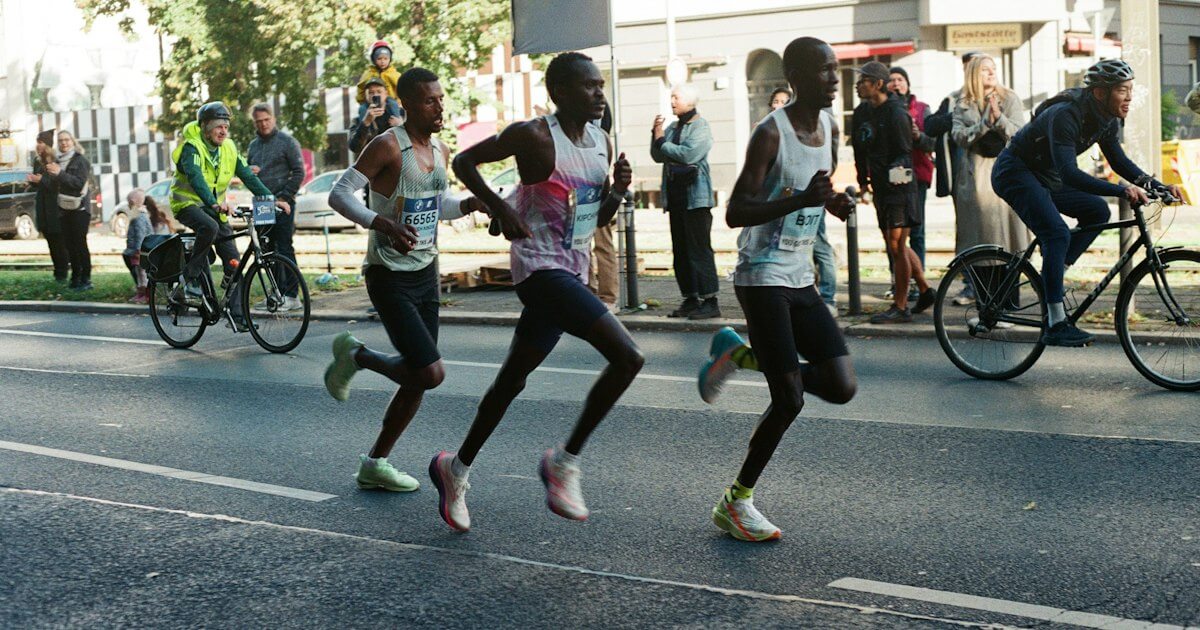
Short answer: To break 3:30 in the marathon, you must hold an average pace of 8:00.6 per mile (4:58.5 per kilometer) across 26.219 miles. In practice, you target 8:00 to 8:01 per mile (4:58 to 4:59/km). Crossing the timing mat at 3:29:48 gives you a modest 12-second cushion against course tangents and GPS wobble. Mass-participation race data indicates that only about 8% to 10% of all marathon finishers break 3:30. If you have already crossed off a sub-1:45 half marathon, run under 44:00 for 10K, and can sustain 45 to 55 miles a week without breakdown, sub-3:30 is your next real target.
The gap between a sub-4 marathon and sub-3:30 is deceiving. It sounds like just 68 seconds faster per mile. But running 8:01/mile for three and a half hours moves you out of purely conversational cruising into steady aerobic threshold work. At this speed, carbohydrate burn rates are dramatically higher, foot impacts are sharper, and any minor pacing error in the first 10 miles gets penalized with interest after mile 20.
The sub-3:30 marathon pace chart
| Checkpoint | Distance | Split time at 8:01/mile (4:59/km) | Cumulative time |
|---|---|---|---|
| 5K | 3.11 mi | 24:53 | 24:53 |
| 10K | 6.21 mi | 24:53 | 49:46 |
| 15K | 9.32 mi | 24:53 | 1:14:39 |
| Halfway | 13.11 mi | 30:13 | 1:44:52 |
| 25K | 15.53 mi | 29:34 | 2:04:26 |
| 30K | 18.64 mi | 24:52 | 2:29:18 |
| 20 miles | 20.00 mi | 10:56 | 2:40:14 |
| 35K | 21.75 mi | 14:04 | 2:54:10 |
| 40K | 24.85 mi | 24:53 | 3:19:03 |
| Finish | 26.22 mi | 10:45 | 3:29:48 |
Notice the halfway split: 1:44:52. That means you have to run two back-to-back 1:44:52 half marathons. If you have not yet proven you can run under 1:45 for a single half, targeting 3:29 on race day is setting yourself up for an expensive lesson in late-race fatigue.
How rare is a sub-3:30 marathon?
Much rarer than running forums make it appear.
Data from RunRepeat's global analysis of millions of race results shows that the median global marathon finish hovers between 4:20 and 4:35. Breaking 3:30 places you in roughly the top 8% to 10% of all marathon finishers worldwide. Among men, roughly 12% to 14% achieve it; among women, roughly 3% to 4% cross under 3:30.
For many age divisions, sub-3:30 is a gateway to competitive club running. It sits near the Boston Marathon qualifying standards for women aged 18–34 (3:30:00) and master men aged 45–49 (3:20:00 to 3:25:00). You can check where this finish lands across demographic brackets in our average marathon time by age chart.
Are you physically ready for sub-3:30?
Before building a 16-week cycle around 8:01/mile, test your engine against three non-negotiable prerequisites:
- A half marathon under 1:40 (or 1:41:00 with deep volume). While Pete Pfitzinger and Jack Daniels formulas suggest a 1:40:00 half converts to roughly 3:30:00, that conversion assumes near-flawless aerobic endurance. If your half PR is 1:44, running 1:44:52 on the first half of a full marathon leaves you with zero aerobic buffer.
- Weekly mileage of 45 to 55 miles (72 to 88 km). Sub-4 can be done on 35 miles per week if you have decent baseline fitness. Sub-3:30 cannot. You need the mitochondrial density and capillary beds that only consistent 50-mile weeks build.
- At least three 20-mile long runs with marathon-pace blocks. Running 20 miles at 9:30 easy pace tells you that your joints can handle the duration. But you also need rehearsals like: 14 miles easy + 6 miles at 8:00 pace, or 2 × 5 miles at 8:01 within a 19-mile long run.
If your 10K is currently over 45 minutes, spend four to six weeks working on top-end aerobic threshold first using our sub-45 10K plan before diving into high-mileage marathon prep.
The metabolic trap: why sub-3:30 attempts fall apart
Marathon fatigue is metabolic, not motivational.
In a landmark quantitative analysis published in PLoS Computational Biology, researcher Benjamin Rapoport (2010) modeled the physiological limits of human glycogen storage during marathon running. His equations proved that running even 2% to 3% faster than your sustainable marathon pace exponentially increases the rate of intramuscular glycogen burn. When you burn through your roughly 2,000 kcal of stored glycogen, your body is forced to oxidize fat at a much slower rate. That drop in ATP replenishment is what runners call the wall.
At an 8:01 pace, you are burning approximately 100 to 110 calories per mile. Over 26.2 miles, that is nearly 2,800 kcal. Because stored liver and muscle glycogen maxes out around 2,000 kcal, you must:
- Ingest 50 to 65 grams of carbohydrates per hour starting at minute 30 (gels or chews with water).
- Keep your cadence high and stride compact to lower the oxygen cost per footstrike.
- Refuse to run 7:45 miles between miles 2 and 8, even when the pack pulls you forward.
Pacing strategy: the 3-phase execution
In a study of over 290,000 marathon runners published in the Journal of Strength and Conditioning Research (Santos-Lozano et al., 2014), researchers discovered that pacing discipline was the primary factor separating fast finishers from those who suffered severe late-race slowdowns. Runners who held steady paces slowed by less than 2% in the second half, whereas runners who went out fast slowed down by an average of 14.8%.
Here is the exact pacing script for breaking 3:30:
Phase 1: Miles 1–4 (8:05–8:10 per mile)
The opening miles will feel absurdly slow. The crowd will surge past you. Let them go. Your adrenaline is flooding your bloodstream, elevating your heart rate artificially. By banking a deliberate 15 to 20 seconds of conservatism over the first four miles, you protect your glycogen tanks and let your core temperature rise gradually.
Phase 2: Miles 5–20 (7:58–8:01 per mile)
This is your cruise control block. Settle into exact race rhythm. Do not speed up on downhills or try to "make up time" because you felt comfortable. Check your splits every 5K against the marathon pace chart. You should hit halfway between 1:44:45 and 1:45:10.
Phase 3: Miles 21–26.2 (Hold the cadence)
At mile 21, the race finally begins. Your legs will feel heavy, and your brain will urge you to lengthen your stride to maintain speed. Lengthening your stride when your neuromuscular system is fatigued creates braking forces that spike eccentric quad loading. Instead of pushing harder with your muscles, lean slightly from the ankles and focus entirely on leg turnover.
The BPM lock: why cadence prevents late-race decay
The most common reason runners miss 3:30 by 3 or 4 minutes is not blowing up completely. It is cadence decay.
Around mile 21, tired hamstrings and calves produce less vertical propulsion. Without realizing it, your step rate drops from 176 down to 166 steps per minute. To maintain 8:01 pace at a lower cadence, you must cover more ground per step—which requires more muscular force from exhausted legs. Within two miles, your pace slips from 8:00 to 8:35, and your 3:29:50 finish slips away.
For most runners running 8:01/mile, the optimal cadence lands between 174 and 180 SPM.
The research on rhythmic acoustic pacing confirms its physical value: in a study published in the Journal of Science and Medicine in Sport (Terry, Karageorghis et al., 2012), synchronous music matched to movement cadence reduced oxygen uptake by 1% to 3% and prolonged endurance time to exhaustion by 18% to 20%.
Here is how to deploy cadence-matched music for a 3:30 attempt:
- Identify your target cadence at 8:01 pace. During your marathon-pace tempo workouts, check your running watch. Most sub-3:30 runners hit between 174 and 178 SPM.
- Build a dedicated race playlist locked to your cadence. A shuffled playlist with songs bouncing from 145 to 190 BPM scrambles your neuromuscular rhythm. Using a tool like GagaRun, you can filter your local music or Apple Music library to only play tracks matching your exact target tempo (e.g., 176 BPM). Footstrike on every beat keeps your cadence pinned to your target pace, eliminating the mental effort of micro-checking your watch every 30 seconds.
- Rely on the beat when brain fog sets in at mile 22. When mental fatigue peaks, your internal clock warps. An external acoustic rhythm acts as a metronome for your central nervous system, preventing the stride collapse explored in our breakdown of why cadence drops when tired.
Sample 8-week peak workout cycle
If you have completed your 8-week base phase, here are three essential quality sessions to rotate through your final two months of prep:
- Marathon Pace Progression: 18 miles total: 8 miles easy @ 9:15, 8 miles steady @ 8:00 (marathon pace), 2 miles cooldown.
- Yasso 800s Speed Check: 10 × 800m on the track in 3:25 to 3:28 with equal-time slow jog recoveries. (Review the mechanics in our Yasso 800s guide).
- The 22-Mile Dress Rehearsal: Run 22 miles 4 weeks before race day: 12 miles @ 9:00, 8 miles @ 8:01 with target race nutrition and BPM audio locked in, 2 miles easy.
FAQ
What treadmill speed is required for a 3:30 marathon?
You need a treadmill belt speed of 7.5 mph (12.06 km/h). To account for lack of wind resistance, set the treadmill incline to 1.0%. If running treadmill training intervals, a pace of 7.6 to 7.7 mph gives you a safe margin above race pace.
Does a sub-3:30 marathon qualify you for the Boston Marathon?
Yes, for several age and gender divisions. For the 2026 and 2027 qualifying cycles, a 3:30:00 or faster qualifies women aged 18–34 (standard is 3:30:00) and easily qualifies master women and master men aged 50 and above. For men aged 18–34, the qualifying standard is 3:00:00, making 3:30 an essential intermediate stepping stone.
What should I do if my cadence drops below 170 at mile 23?
Do not try to stride out or leap forward. Shorten your arm swing and bring your hands slightly higher toward your chest. Your legs naturally mirror your arm turnover. Lock into your 176 BPM audio cues and focus on quick, quiet foot taps rather than power.