
HYROX Sandbag Lunges BPM: Cadence & Pacing Strategy
Alex Chen, Certified Running Coach
September 23, 2026
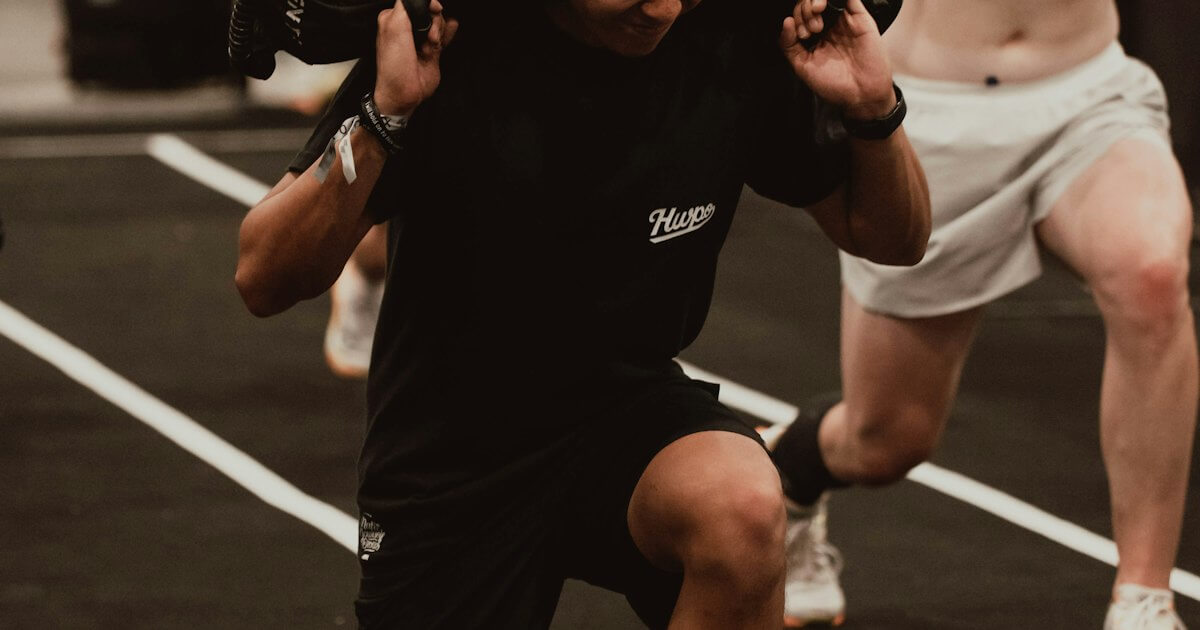
HYROX Sandbag Lunges BPM: Cadence & Pacing Strategy
Direct answer: To finish HYROX Station 7 (100m Sandbag Lunges) in 4:00 to 4:45 without frying your quadriceps, lock your movement to 32–38 lunges per minute (roughly 1.6 to 1.8 seconds per repetition). The most reliable acoustic anchor is a 140–152 BPM playlist using a 4-beat cycle: step forward on beat 1, tap your trailing knee on beat 2, drive through the front heel on beat 3, and stand fully extended on beat 4.
At 100 meters, an average stride length of 1.15 to 1.3 meters requires 75 to 88 total lunges. Sprinting the first 25 meters at 50 lunges per minute spikes blood lactate and triggers quad failure right around the 60-meter turnaround, turning the back half into an agonizing start-stop crawl.
Station 7 Race Standards and Equipment Rules
Before talking rhythm, you need the cold parameters. HYROX enforces strict movement standards at Station 7. Unlike gym lunges where you can drop the bar or take breather steps, HYROX judges issue immediate time penalties for sloppy mechanics.
| Division | Distance | Sandbag Weight | Target Time (Good) | Average Finish |
|---|---|---|---|---|
| Open Women | 100 m (4 × 25 m lanes) | 10 kg (22 lbs) | 4:10–4:40 | 5:00–5:30 |
| Open Men | 100 m (4 × 25 m lanes) | 20 kg (45 lbs) | 3:50–4:25 | 4:30–5:00 |
| Pro Women | 100 m (4 × 25 m lanes) | 20 kg (45 lbs) | 4:30–5:00 | 5:15–5:45 |
| Pro Men | 100 m (4 × 25 m lanes) | 30 kg (66 lbs) | 4:15–4:45 | 4:55–5:25 |
Non-Negotiable HYROX Rules
- The Sandbag Must Stay On Your Shoulders: The sandbag must rest across both shoulders or behind the neck at all times. Setting the bag down on the floor, on lane barriers, or across your knees triggers an immediate 15-second penalty with no prior warning. A second infraction brings disqualification.
- Trailing Knee Ground Contact: Your back knee must clearly touch the arena carpet on every single repetition. A judge watching from the side will issue a formal warning on the first missed tap and a 15-second penalty on the second.
- Full Extension at the Top: Each lunge repetition only counts once you stand tall with hips and knees completely locked out.
- No Shuffling or Extra Steps: You can pause with both feet parallel at the top of a repetition to breathe, but taking extra steps, shuffling feet forward, or stutter-stepping between lunges is strictly prohibited.
Why Athletes Blow Up at Meter 55
By the time you enter Station 7, you have already completed 7 kilometers of running, 1,000 meters on the SkiErg, a heavy sled push workout, a sled pull, 80 meters of burpee broad jumps, 1,000 meters of rowing, and 200 meters of farmer's carries.
Your legs are swimming in systemic fatigue. Walking lunges impose a heavy eccentric braking load on your quadriceps and patellar tendons as you decelerate bodyweight plus external load into each descent.
A biomechanical study on loaded lunges published in the Journal of Strength and Conditioning Research (Riemann et al., 2012) showed that ground reaction forces and knee joint moments spike sharply during the initial deceleration phase. When athletes move erratically without a pacing cue, they rush the drop, slam their trailing knee into the floor, and rely almost entirely on concentric knee extensor torque to heave themselves back up.
Do that 30 times in the first 90 seconds, and local muscular acidosis peaks. Your quads lock up, your lower back rounds under the bag, and you spend the next three minutes frozen in place with hands on your knees while the clock ticks away.
The BPM Solution: 4-Beat Cadence vs 2-Beat Cadence
External rhythmic pacing removes the urge to speed up when adrenaline spikes at the station entrance. Two distinct musical cadence structures keep your lunges smooth and sustainable.
Option A: 4-Beat Cycle (Recommended)
Music Tempo: 140–152 BPM
Beat 1: Step forward & initiate descent
Beat 2: Trailing knee softly taps carpet
Beat 3: Drive through front heel & extend hips
Beat 4: Stand tall, feet parallel, full lockout
Output: 35–38 lunges per minute (1.58–1.71 seconds per rep)

Option B: 2-Beat Half-Time
Music Tempo: 70–76 BPM
Beat 1: Step forward and descend
Beat 2: Drive up to full hip lockout
Output: 35–38 lunges per minute
Why is the 4-beat pattern at 144 BPM superior for 90% of competitors?
Because 144 BPM matches the tempo of standard electronic, house, and modern workout tracks. More importantly, four discrete beats subdivide the movement into equal quarters: you give equal time to the descent (beats 1–2) and the ascent (beats 3–4). This prevents you from "dive-bombing" into the bottom and bouncing off your knee joint.
Pacing Breakdown: 100m Sandbag Lunges
| Division & Target Finish | Total Lunges | Target Rep Cadence | Music BPM (4-Beat) | Pace per 25m Lane |
|---|---|---|---|---|
| Elite (Sub-3:45) | 72–78 reps | 38–42 reps/min | 152–168 BPM | 50–55 sec |
| Competitive (Sub-4:15) | 76–82 reps | 35–38 reps/min | 140–152 BPM | 58–63 sec |
| Solid Open (Sub-4:45) | 80–86 reps | 32–35 reps/min | 128–140 BPM | 67–72 sec |
| Survival (Over 5:30) | 84–92 reps | < 28 reps/min (Stalling) | Unsynced / Stopping | > 85 sec |
Even pacing is mathematically proven to save energy in high-intensity functional events. Abbiss and Laursen's landmark review on pacing strategies (Sports Medicine, 2008) highlighted that an even distribution of work output minimizes glycogen depletion and prevents premature neuromuscular fatigue compared to an aggressive all-out start.
How to Set Up the Sandbag for Minimal Energy Leak
Good rhythm requires a stable anchor. If the sandbag shifts around on your upper spine, your torso will pitch forward, forcing your spinal erectors and hip flexors to work double time.
- Center the Load High on Traps: Place the bag across the meat of your upper trapezius, not resting directly against the cervical spine (C7 vertebra). Keep your chest proud and ribs pulled down.
- Pull the Handles Downward: Grip the side or center handles firmly and pull the bag into your back. Treating the bag like a rigid barbell creates whole-body tension and prevents horizontal shifting.
- Step Narrow and Straight: Walk as if your feet are tracking on parallel railroad tracks rather than a tightrope. Stepping too narrow creates lateral wobble; stepping too wide bleeds forward momentum.
- Drive Through the Entire Front Foot: Don't press only off your front toes. Keep your front heel grounded and push the floor away to recruit the gluteus maximus rather than overloading the patellar tendon.
Locking Your Playlist With GagaRun
In a crowded HYROX arena, you cannot afford to fumble with a phone screen to skip a song that suddenly drops into a 90 BPM slow jam or an unpredictable 175 BPM drum and bass track.
This is where GagaRun solves the execution problem. The app analyzes your existing Apple Music or Spotify library and organizes your tracks by exact BPM. You set a target tempo window—such as 140 to 148 BPM—and GagaRun streams continuous, high-energy music strictly within that cadence bracket.
Every stride lands on the downbeat. When you emerge from the lunges and transition into the final 1 km run before the wall ball workout, your legs have avoided lactic catastrophe, allowing you to settle immediately back into your normal HYROX running cadence.
Frequently Asked Questions
Can I stop and rest between lunges in HYROX?
Yes, you can pause at the top of any repetition with both feet parallel and your knees and hips fully extended. You can take several deep breaths before stepping into the next rep. However, the sandbag must remain on both shoulders the entire time; dropping the bag to the floor results in an automatic 15-second penalty.
How many steps is 100 meters of walking lunges?
Most adult athletes complete 100 meters in 74 to 88 lunges. Taller competitors with efficient hip mobility average roughly 70–76 steps (around 1.35 meters per stride), while shorter athletes typically log 84–92 steps (around 1.15 meters per stride).
Should I hold the sandbag on one shoulder or across my neck?
HYROX rules permit the sandbag to rest across your shoulders, but resting it centrally across the back of the neck and traps (back-squat style) distributes weight symmetrically across both hips. Placing the bag on a single shoulder creates lateral spinal flexion, accelerates oblique fatigue on one side, and disrupts your forward balance over 100 meters.





