Tabata Workout BPM: Match Music To The 20/10 Protocol
Sarah Jenkins, Fitness Physiologist
2026年7月2日
Short answer: For a true Tabata round (20 seconds all-out, 10 seconds rest, ×8), play 150–180 BPM music during work and drop to 110–125 BPM during rest. You don't need to sync every rep to the beat — Tabata is too fast for that — but the tempo contrast tells your nervous system when to go and when to stop pretending the rest is optional.
Most Tabata sessions I watch fall apart for the same reason: the playlist never changes. Round 1 feels explosive. Round 5 feels like moderate cardio with extra sweating. By round 8, people are moving at roughly 60% effort and calling it HIIT.
What Tabata actually is (not "20 minutes of burpees")
Tabata is a specific interval protocol from a 1996 study by Izumi Tabata and colleagues in Medicine & Science in Sports & Exercise. The formula is fixed:
- 20 seconds of maximal effort
- 10 seconds of rest
- Repeat 8 times = 4 minutes total
Tabata et al. had subjects cycle at roughly 170% of VO₂max for those 20-second bouts. After six weeks of training five days per week, the Tabata group improved VO₂max by about 14% and anaerobic capacity by 28%. The moderate-intensity group trained 60 minutes per session at 70% VO₂max and saw smaller aerobic gains with zero anaerobic improvement.
That's the whole point. Tabata is brutally short because the intensity has to be genuine. A 20-minute "Tabata-style" class with 40-second work periods is a different workout wearing the same label.
Why BPM matters when you can't count reps
Wait — if Tabata is only 20 seconds, do you even need music tempo?
You need an external pacing signal, yes. Twenty seconds is long enough for your brain to sandbag, short enough that you won't notice until the round is over. Music fixes two problems at once:
- Work intervals: Fast tempo (150–180 BPM) raises arousal and keeps movement frequency high during bodyweight circuits, bike sprints, or kettlebell swings.
- Rest intervals: Slower tempo (110–125 BPM) creates a perceptible downshift so you actually recover instead of hovering at 80% effort.
Karageorghis and colleagues tested this directly. In a HIIT study published in the Journal of Sport & Exercise Psychology (2021), medium-tempo music at 120–125 BPM during active recovery lowered rating of perceived exertion compared to a no-music control. Fast-tempo tracks at 135–140 BPM increased dissociation and remembered enjoyment. Terry et al.'s 2020 meta-analysis in the Psychological Bulletin (139 studies, 3,599 participants) found music reduced perceived exertion with an effect size of g = 0.22 — modest, but real when you're repeating eight rounds.
At true maximal effort, music won't magically make round 8 easy. Internal fatigue signals win. But for the 90% efforts most people actually hit in gym Tabata, tempo contrast is the cheapest enforcement tool you have.
Tabata BPM targets by exercise type
| Phase | Duration | Target BPM | What It Does |
|---|---|---|---|
| Warm-up | 3–5 min | 110–120 BPM | Raise heart rate without pre-fatiguing |
| Work interval | 20 sec | 150–180 BPM | Drive max output; match foot/rep cadence if applicable |
| Rest interval | 10 sec | 110–125 BPM | Signal recovery; resist "active rest" at work tempo |
| Between rounds | 1–2 min | 100–110 BPM | Full reset if doing multiple 4-min blocks |
| Cool-down | 3–5 min | 90–100 BPM | Parasympathetic shift |
Bodyweight Tabata (burpees, mountain climbers, squat jumps)
Don't try to hit every beat on burpees — one rep takes 3–5 seconds. Instead, use 160 BPM music as an energy frame and count reps internally. Our burpee BPM guide breaks down the 4-count lock for longer AMRAPs; Tabata burpees are the opposite — max reps, no pacing math.
For mountain climbers, 170–180 BPM works well because each knee drive can land on or near the beat.
Cycling / assault bike Tabata
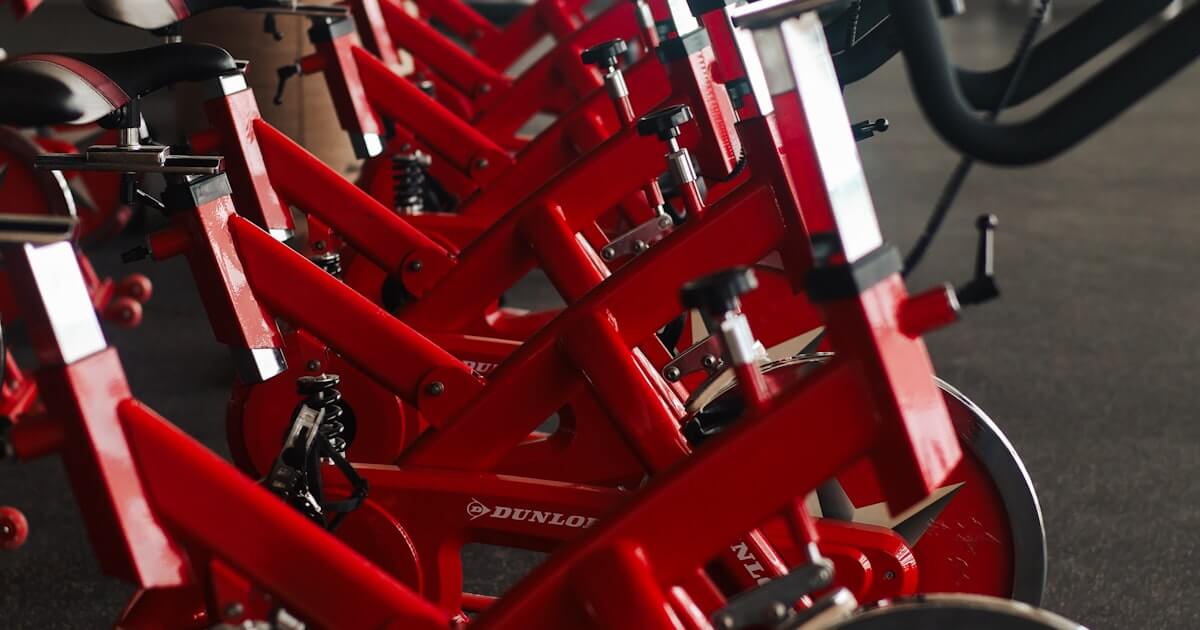
This is the original Tabata modality. Hold 170+ RPM on the fan bike during work intervals. Play 175–180 BPM music — the leg turnover maps cleanly to the beat. See our Assault Bike BPM guide for fan-bike-specific pacing.
Kettlebell swings Tabata
Swings run at roughly 40–50 BPM (one swing per 1–1.5 seconds). Use 160 BPM at half-time — one swing every four beats — or filter to 80 BPM tracks if your library has them. Our kettlebell swing BPM guide covers the full rep-to-beat math.
Three Tabata workouts with exact BPM plans
Workout 1: Classic bodyweight Tabata (beginner)
Exercise: Squat jumps (or step-back burpees if jumping hurts your knees)
- Warm up 4 minutes: dynamic leg swings + 90-second jog at 115 BPM.
- Round 1: 20s squat jumps at 165 BPM / 10s rest at 115 BPM × 8.
- Rest 2 minutes at 100 BPM. Walk, don't jog.
- Round 2: 20s mountain climbers at 170 BPM / 10s rest at 115 BPM × 8.
- Cool down 3 minutes at 95 BPM.
Total time: about 18 minutes. If you can't maintain jump height by round 6, your opening intensity was too high. Scale down next session.
Workout 2: Bike Tabata (intermediate — closest to the original study)
- Warm up 5 minutes at 60% max effort, 120 BPM music.
- Tabata block: 20s all-out / 10s easy spin × 8 at resistance that lets you hit 170% VO₂max effort (roughly: can't speak, legs burning by round 4).
- Work music: 175 BPM. Rest music: 120 BPM.
- Cool down 4 minutes, 100 BPM.
One block is enough for most people. Two blocks separated by 3 minutes of easy spinning is advanced.
Workout 3: Mixed-modal Tabata (advanced)
Rotate exercises each work interval to prevent local muscle failure from ending the round early:
| Round | Exercise | Work BPM | Rest BPM |
|---|---|---|---|
| 1 | Kettlebell swings | 80 BPM (half-time from 160) | 115 BPM |
| 2 | Push-up to T | 160 BPM | 115 BPM |
| 3 | Assault bike sprint | 175 BPM | 120 BPM |
| 4 | Battle ropes | 130 BPM | 115 BPM |
| 5–8 | Repeat rounds 1–4 | Same | Same |
Battle rope waves at 130 BPM use the same half-time logic as StairMaster 25-7-2 training — the beat is faster than your hands, so you hit every other beat.
Build your Tabata playlist without tempo whiplash
The hardest part isn't finding fast songs. It's switching between work and rest tempos eight times in four minutes without fumbling your phone.
Manual approach: pre-build a 4-minute mix where every 20-second segment is a 160+ BPM track and every 10-second gap is a 115 BPM instrumental. Podrunner's Tabata mixes use exactly this structure — 180 BPM work / 150 BPM rest alternation.
Automated approach: GagaRun filters your library to a target BPM band. Set a 165 BPM work playlist before the timer starts, switch to a 115 BPM recovery list between blocks, and stop skipping tracks mid-round looking for something faster.

For steady-state days between Tabata sessions, keep intensity low with our LISS cardio BPM guide — stacking Tabata on top of junk-mile running is how people overtrain in four weeks.
FAQ
What BPM is best for Tabata?
150–180 BPM during 20-second work intervals for most bodyweight and cardio modalities. 110–125 BPM during 10-second rests. Exact numbers matter less than the contrast between work and rest — if both phases sound the same, you'll drift to one effort level.
Can I use one playlist for the entire Tabata session?
You can, but you'll lose the rest/work contrast. Karageorghis's 2021 HIIT research showed medium-tempo recovery music specifically reduced RPE during rest periods. One high-BPM playlist for four straight minutes works for motivation; it doesn't teach your body to actually recover in 10 seconds.
Is Tabata better than 30/60 treadmill HIIT?
Different tools. Tabata demands near-maximal output in 20-second windows — brutal for conditioning, hard to repeat daily. 30/60 treadmill HIIT uses longer work periods with more recovery, making it easier to sustain across 8–10 rounds. Use Tabata 1–2× per week; use longer HIIT for volume.
How is Tabata different from Norwegian 4×4?
Norwegian 4×4 intervals use 4 minutes at 90–95% max heart rate with 3 minutes recovery — aerobic power development. Tabata uses 20 seconds at supramaximal effort with 10 seconds rest — anaerobic and VO₂max stimulus in four minutes. The BPM strategy differs: 4×4 needs sustained 160–170 BPM for four full minutes; Tabata needs rapid tempo switching.
Do I need to sync every movement to the beat?
No. At true Tabata intensity, perfect beat-matching is unrealistic for multi-joint movements like burpees. Use BPM as an arousal and phase marker, not a metronome contract. Cycling and mountain climbers sync well; burpees and swings use half-time or internal counting.