Running Pace, Cadence & Stride Length: Formula And Chart
GagaRun
July 22, 2026
Running speed = cadence × distance per step. Running pace is the inverse: minutes per km = 1,000 ÷ (SPM × meters per step). SPM counts steps from both feet. A full stride spans two steps, so do not multiply SPM by a full-stride distance.
Use the formulas and goal-pace chart below to calculate how your measured cadence and step length relate to pace. They describe movement, not a single correct cadence or a promise that you can sustain a combination for a race.
Running pace, cadence and step length: formulas and units
Cadence in SPM means steps per minute, counting both feet. Here, step length means distance per footfall. A full left-to-left or right-to-right stride spans two steps. If you use meters per full stride, use strides per minute as well; combining that distance with SPM would double the calculated speed.
Speed in meters per minute = cadence in steps per minute × step length in meters per step.
A runner at 170 SPM with a 0.95-meter average step length covers 161.5 meters per minute, approximately a 9:58/mile pace. A 9:00 mile requires about 178.82 meters per minute. Cadence, step length or both must increase to produce that speed.
To calculate pace from these units, divide the distance by speed: minutes per mile = 1,609.344 ÷ (SPM × meters per step). Minutes per kilometer uses 1,000 in place of 1,609.344.
For the same units, you can solve for whichever measurement is missing:
| Measurement to Calculate | Formula |
|---|---|
| Pace in minutes per kilometer | P = 1,000 ÷ (SPM × step length) |
| Step length in meters per step | Step length = 1,000 ÷ (P × SPM) |
| Cadence in steps per minute | SPM = 1,000 ÷ (P × step length) |
Here P is minutes per kilometer, and step length is meters per step. For mile pace, replace 1,000 with 1,609.344. A stopwatch-derived average pace and cadence should cover the same section of your run.
Goal-pace chart: cadence and meters per step
Each cell shows the average meters per step required at that cadence to hold the listed pace. Distances are rounded to 0.01 meters; kilometer paces are rounded to the nearest second. These are calculated examples, not measured averages or recommended targets. To use the chart: find your goal-pace row, find the column closest to your measured SPM, then read the meters-per-step value where they meet. The listed cadence columns are examples, not targets to adopt.
| Goal Pace (per mile) | Per km | 165 SPM | 170 SPM | 175 SPM | 180 SPM |
|---|---|---|---|---|---|
| 12:00 | 7:27 | 0.81 m | 0.79 m | 0.77 m | 0.75 m |
| 11:00 | 6:50 | 0.89 m | 0.86 m | 0.84 m | 0.81 m |
| 10:00 | 6:13 | 0.98 m | 0.95 m | 0.92 m | 0.89 m |
| 9:00 | 5:36 | 1.08 m | 1.05 m | 1.02 m | 0.99 m |
| 8:00 | 4:58 | 1.22 m | 1.18 m | 1.15 m | 1.12 m |
| 7:00 | 4:21 | 1.39 m | 1.35 m | 1.31 m | 1.28 m |
| 6:00 | 3:44 | 1.63 m | 1.58 m | 1.53 m | 1.49 m |
Check any cell using one mile = 1,609.344 meters. For a 10:00 mile at 175 SPM: 1,609.344 ÷ 10 ÷ 175 = 0.9196 meters per step, displayed as 0.92 meters.
At a constant 175 SPM, moving from a 10:00 mile to a 9:00 mile corresponds to about 10 centimeters more per step. That arithmetic does not establish how easy the change will be or how long you can maintain it. Your ability to sustain the faster pace still depends on training and effort.
Measure your cadence and calculate your step length
Measure cadence and pace during the same steady section of a run so that the calculated average step length describes that section.
- Measure your cadence. Count your right foot's landings for 30 seconds and multiply by four to get total SPM. Or count both feet for 60 seconds with no multiplier. For another example, see what a 160 SPM cadence means.
- Calculate your step length. Convert your measured pace to meters per minute, then divide by SPM. A runner covering 5K in 28 minutes at an average 160 SPM has a calculated average step length of 5,000 ÷ 28 ÷ 160 = 1.12 meters.
- Record pace, cadence and effort together. Repeat the measurement under similar conditions when you want to compare sessions. An average step length cannot show where your foot lands relative to your body.
What changes when you increase cadence at the same pace?
Heiderscheit et al. (2011) tested 45 healthy runners at constant speed. Knee energy absorption decreased at +5% and +10% cadence; hip energy absorption decreased significantly at +10%. Foot contact moved closer to the body's center of mass. The study measured immediate mechanics, without establishing injury prevention or a long-term adaptation schedule.
If you choose to experiment with a small change, a 5% increase from 160 SPM is 168 SPM. Try it at the same speed first: a cadence increase there means a shorter average step, not a faster run. Assess the result instead of treating 168 or 180 SPM as a universal goal.
Music or a metronome can give you a rhythm to practice following. For 168 SPM, try one step per beat at 168 BPM or two steps per beat at 84 BPM. A beat is a cue; it does not make every runner synchronize automatically.
What training studies show about faster running
A longer step in the equation is an outcome to measure, not a cue to reach your foot farther forward. The chart cannot assess your running form, and simply increasing distance per step does not establish better efficiency.
Training options such as strides, hills and plyometrics serve different purposes. They do not need to form a fixed sequence in which every runner raises cadence first and locks it for the rest of the program.
- Strides: Short, controlled accelerations are one way to practice faster running. See our strides workout guide for a session example; choose a workload that fits your current training.
- Hills: Uphill repetitions change the demands of a session. They do not make overstriding impossible or guarantee longer steps on flat ground.
- Plyometrics: Two small studies illustrate possible effects when added to regular running. Spurrs et al. (2003) studied 17 male runners over six weeks; the intervention group improved 3K performance by 2.7%, with no recorded change in VO2max. Saunders et al. (2006) studied 15 highly trained runners over nine weeks; running economy improved by 4.1% at 18 km/h, but not significantly at 14 or 16 km/h. These findings do not promise the same improvement, or a particular increase in step length, for another runner.
Compare your pace, cadence and effort over time rather than expecting cadence to stay fixed. A faster pace with the same measured cadence corresponds to a longer average step by definition, but the equation alone cannot identify the cause of the change.
Check the numbers at your goal pace
During a session appropriate to your training, measure your cadence at the goal pace and calculate the resulting average step length. A watch, measured route or treadmill checks the speed; music supplies a rhythm cue. Completing intervals at a pace does not guarantee that you can sustain it for a whole race. For the pacing side of race preparation, see our 5K pacing strategy guide.
Frequently asked questions
Is stride length the same as step length?
A full stride runs from one foot's landing to that same foot's next landing and contains two steps. This chart uses meters per step with steps per minute. If you use a full-stride distance instead, use strides per minute so the units remain consistent.
How do I calculate pace from cadence and step length?
With cadence in SPM and step length in meters per step, minutes per km = 1,000 ÷ (SPM × step length). For minutes per mile, use 1,609.344 instead of 1,000. Both numbers must describe the same steady section of a run.
How do I find step length from my pace?
For kilometer pace in minutes, meters per step = 1,000 ÷ (pace × SPM). At 5:00/km and 170 SPM, that is 1,000 ÷ 5 ÷ 170 = approximately 1.18 meters per step. Use unrounded values when checking a calculation.
Should I increase cadence or step length first?
There is no universal order. Measure your current pace and cadence first. A small cadence experiment at constant speed tests a different question from training to sustain a faster pace. Use comfort, performance and your individual needs to assess a change.
Is a longer step the same as reaching farther forward?
No. Average step length is the distance covered per footfall. It does not tell you where that footfall occurs relative to your body, and it should not be used as an instruction to reach farther forward.
Do I need to hit 180 steps per minute?
No single cadence is required by the equation. At a 10:00 mile, 180 SPM corresponds to about 0.89 meters per step, while 165 SPM corresponds to about 0.98 meters. The table supplies the arithmetic, rather than selecting a target for you.
How long until I see a faster race time?
The six- and nine-week research programs above describe their study durations, not a guaranteed timetable for individual improvement. Neither establishes a universal 12-week path to a faster 5K. Track your own progress with comparable sessions and race efforts.
Optional: practice a selected rhythm with music
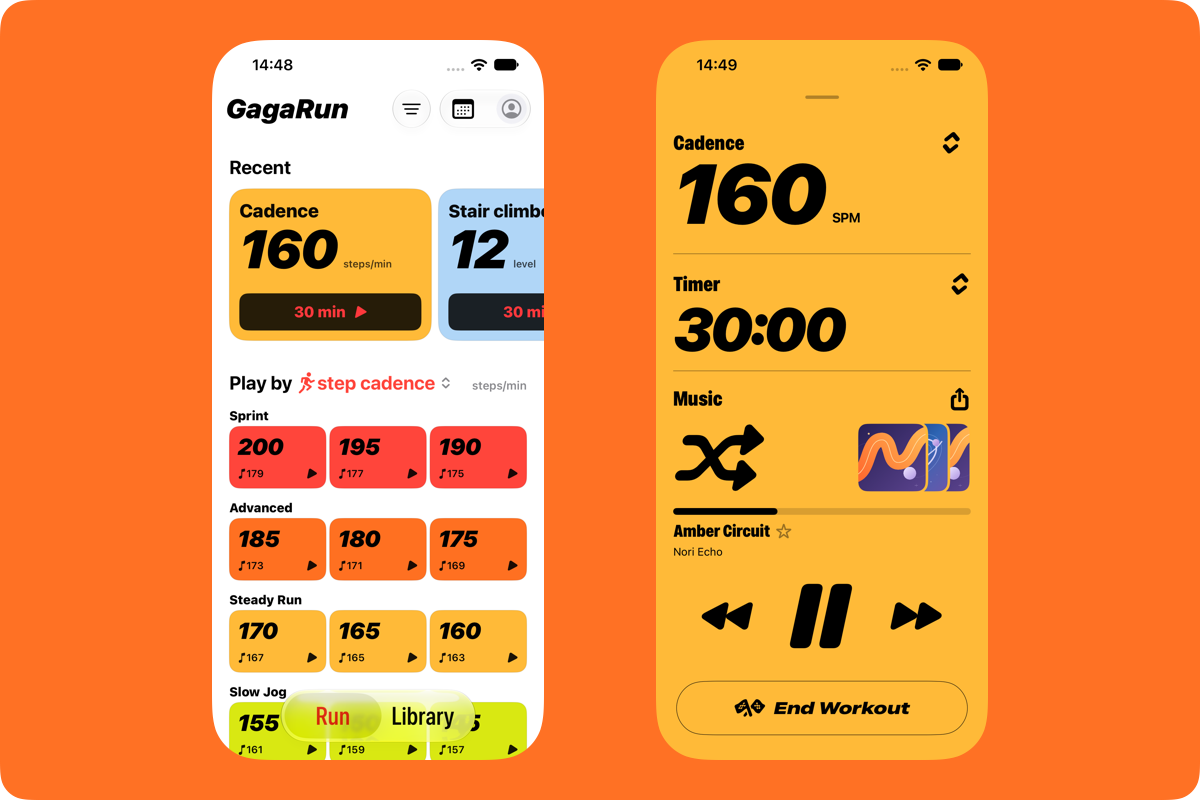
Try GagaRun for iPhone for Apple Music playback with an available target SPM you select. If your playlist is on another service, use a transfer workflow supported in your region and check the resulting Apple Music matches before importing it. A separate Apple Music subscription is required. Check the target options and playback controls supported by your installed version and plan. Use BPM analysis as a rhythm reference while measuring cadence and pace independently.