Aqua Jogging BPM Guide: Match Music To Pool Running Cadence
Alex Chen, Certified Running Coach
May 31, 2026
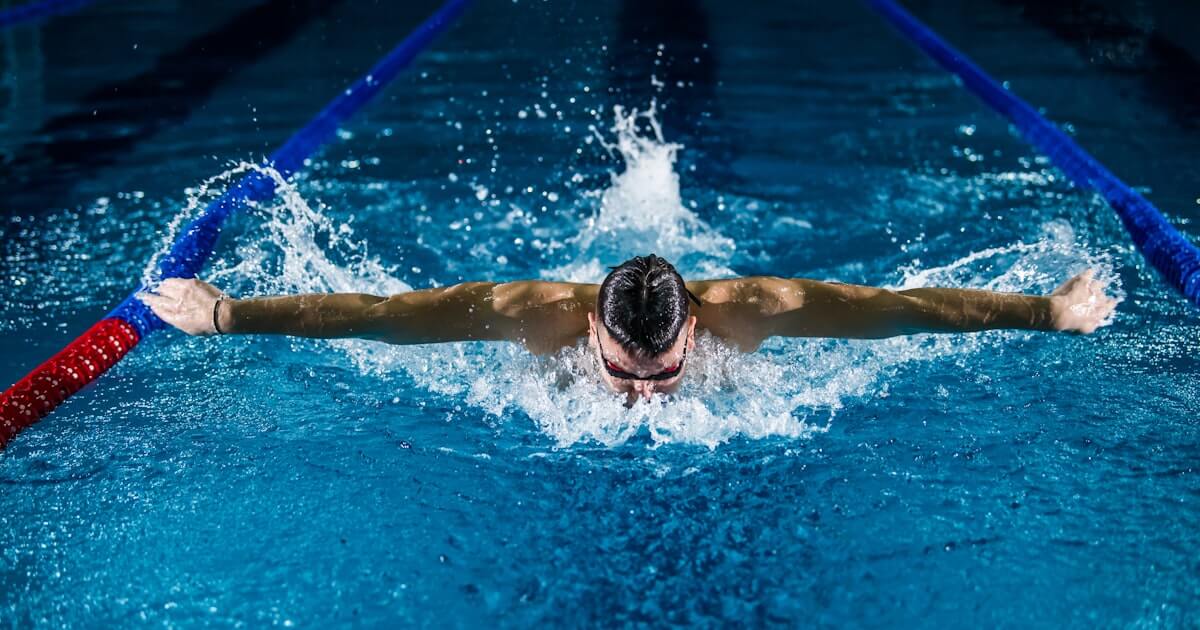
For deep water aqua jogging, match music at 100–120 BPM using a half-time sync: take one full leg cycle on every two beats. That lands you at roughly 50 cycles per minute for easy aerobic work and 60 cpm for harder tempo sessions—the sweet spot research identifies for pool running without fighting water resistance.
What is aqua jogging?
Aqua jogging (deep water running) is running-form cardio in water deep enough that your feet never touch the pool floor. You wear a flotation belt, stay upright, and pump your arms and legs like you would on a treadmill—except water removes virtually all impact loading.
Most runners show up for one of two reasons: they need to stay fit through shin splints, stress fractures, or plantar issues, or they want extra volume without trashing their joints. A PMC review of deep water running in trained athletes found that six runners who switched entirely to pool training for eight weeks held their aerobic capacity steady—even though land training stopped for injury (Masumoto et al., 2014).
Wait—so the problem isn't your fitness. It's that pool running feels weird, your legs drift into slow-motion, and without a pacing cue you either sandbag the session or thrash yourself into anaerobic panic.
Why land-running BPM rules fail in the pool
This trips up almost every injured runner I coach. On land, you might lock 165 BPM music to 165 steps per minute. In water, that cadence is physically impossible. Drag increases exponentially with speed—you're moving through a medium roughly 800 times denser than air.
Research on young active females running at chest depth found that 50 stride cycles per minute hit mainly aerobic intensity (~35% HRmax and VO2max), while 60 cpm pushed into mixed aerobic-anaerobic territory (~50% HRmax). Deep and shallow water produced similar metabolic cost at matched cadences (Acta Scientific Orthopaedics, 2021).
Translation: your pool "cadence" is measured in cycles per minute (cpm)—one full left-right leg rotation—not the 150–170 SPM you'd see on a GPS watch.
The aqua jogging BPM chart
Use a 1:2 half-time ratio: one complete running cycle lands on every two musical beats. Same trick as StairMaster half-time stepping at 130 BPM—the beat is faster than your movement, but your brain locks in cleanly.
| Session type | Target RPE | Stride cycles/min | Music BPM (half-time) | Feels like |
|---|---|---|---|---|
| Warm-up / mobility | 3–4 | 40–45 cpm | 80–90 BPM | Easy water walking with run arms |
| Aerobic base (Zone 2) | 5–6 | 48–52 cpm | 96–104 BPM | Conversational effort, steady turnover |
| Tempo / threshold | 7–8 | 58–62 cpm | 116–124 BPM | Hard but controlled; can't chat |
| Intervals (work) | 9 | 65–70 cpm | 130–140 BPM | Short bursts only (30–90 sec) |
| Recovery between intervals | 4 | 40 cpm | 80 BPM | Slow legs, deep breathing |
Your heart rate in water runs 10–17 bpm lower than land at the same perceived effort. Don't chase your usual Zone 2 numbers on a chest strap—trust RPE and cadence instead.
Why synchronous music actually works underwater
Pool running is boring in a very specific way. No scenery. No footstrike feedback. Just resistance and the faint smell of chlorine.
Synchronous music—movement locked to the beat—fixes the pacing drift. A pilot study on elliptical exercise found that cadence-matched music cut heart rate and Borg RPE versus asynchronous tracks or white noise, with satisfaction scores averaging 8.3/10 versus 5.2 for mismatched music (Music and Medicine, 2019).
In hot conditions, synchronous music lowered steady-state RPE by roughly 22% at identical workloads (Frontiers in Psychology, 2018). Pool decks aren't always hot, but the dissociation effect transfers: when your legs match the beat, you stop negotiating with yourself about whether 52 cpm "feels hard enough."
How to sync your aqua jog to music
- Count your baseline: Aqua jog easy for 60 seconds. Count full leg cycles (left-right = 1). Most trained runners land between 45–55 cpm without trying.
- Double it for BPM: 50 cpm → set music to 100 BPM half-time. Tap your foot cycle on beats 1 and 3 of a 4-count, or simply one cycle every two beats.
- Posture check every 5 minutes: Ears over shoulders, eyes forward, core engaged. Leaning forward kills turnover—the belt supports you, not your slouch.
- Build a session arc: 5 min at 90 BPM → 20 min at 100 BPM → 5 min at 110 BPM → 5 min cooldown at 85 BPM.
- Transition back to land carefully: When you return from injury, use our comeback BPM plan—pool fitness doesn't automatically transfer to impact tolerance.
Lock pool cadence without building 47 playlists
I've tried building separate 100 BPM, 120 BPM, and 140 BPM pool playlists by hand. It gets old fast. Bluetooth dropout mid-lap doesn't help either.
GagaRun pulls from your Apple Music or Spotify library at whatever BPM you set—100 for aerobic base, 120 for tempo blocks, 80 for recovery. Half-time sync is still a cue you hold in your head once you're in the water. The app just keeps the tempo locked so you're not fumbling with wet fingers between laps.

Sample 45-minute aqua jogging workout
| Block | Duration | BPM | Cycles/min | Notes |
|---|---|---|---|---|
| Warm-up | 8 min | 88–92 | ~44 | High-knee drills, easy arm pumps |
| Steady aerobic | 20 min | 100 | ~50 | Main fitness block; RPE 5–6 |
| Tempo push | 8 min | 120 | ~60 | Controlled hard effort |
| Cooldown | 5 min | 85 | ~42 | Heart rate drifts down |
| Optional strides | 4 × 30 sec | 135 | ~67 | Only if pain-free; full recovery between |
Common aqua jogging mistakes
Chasing land cadence. Forcing 160+ SPM mechanics in water shortens your stride against resistance and spikes hip flexor load. Stay in the 48–62 cpm lane unless you're doing brief intervals.
Ignoring form for heart rate. Sloppy scissor kicks feel harder but train nothing. Strict running posture—compact cycles, 90° arm drive—keeps VO2 closer to land-running values.
Skipping the belt too early. The flotation belt isn't cheating. It lets you focus on turnover instead of treading water. Drop it only after 3–4 sessions of clean form.
Only easy jogging. Pool intervals (130–140 BPM half-time, 30–60 seconds on / 90 seconds float-recovery) maintain neuromuscular sharpness better than monotone 45-minute plods.
Frequently asked questions
What BPM is best for aqua jogging?
For most injured runners doing aerobic maintenance, 100 BPM with half-time sync (~50 stride cycles per minute) is the default. Push to 116–124 BPM for tempo work (~58–62 cpm). Reserve 130+ BPM for short intervals only.
Can I use my normal running playlist in the pool?
Only if those tracks sit in the 96–124 BPM range. A 170 BPM sprint playlist will push impossible turnover in water. Build separate pool targets—or use tempo-adjustment tools rather than recycling land-running lists unchanged.
Does aqua jogging maintain running fitness?
Yes, for roughly 4–6 weeks of exclusive pool training in trained runners, VO2 and performance markers hold steady when intensity and duration match your land plan. It's a bridge, not a permanent replacement—but it's a legitimate bridge.
Should I match music to heart rate or leg cadence in water?
Leg cadence. Heart rate suppression in water makes HR zones unreliable. Cadence-matched music gives you an external clock that RPE alone can't provide—especially when you're staring at the lane line wondering if you've been going for eight minutes or eighteen.