2K Row Pacing Strategy: Splits, Stroke Rate & BPM Guide
Alex Chen, Certified Running Coach
2026年8月29日
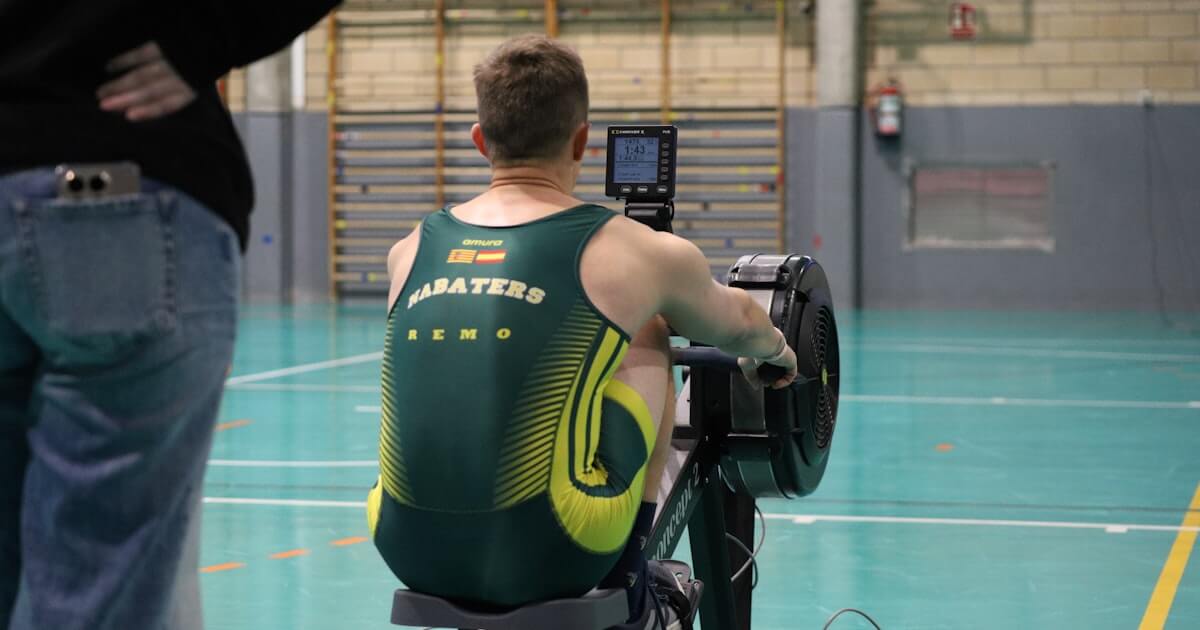
TL;DR: The fastest way to race a 2,000m row test on a Concept2 ergometer is a controlled J-curve pacing strategy: take 5 hard strokes to spin up the flywheel, settle by 250m into a base stroke rate of 30–34 SPM (at your target 500m split), hold that split flat through 1,500m, and lift your stroke rate to 36–40 SPM for the final 250m sprint. Matching your drive rhythm to 120–136 BPM music (using a 4-beat per stroke cycle) prevents the fatal mistake of "rushing the slide" when fatigue peaks in the third 500m.
Why most 2K row tests fail in the third 500 meters
The 2,000-meter erg test is the universal benchmark of physical and mental capacity in rowing, CrossFit, and hybrid endurance training. For most athletes, a 2K test lasts between 6 and 8 minutes—putting it square at the boundary where aerobic capacity and anaerobic lactic tolerance collide.
The classic disaster pattern is the "Fly and Die":
- Adrenaline spikes on stroke one.
- The rower pulls 4–6 seconds faster than target pace for the first 300 meters.
- Lactic acid floods the bloodstream by meter 800.
- By the 1,200m mark (the "third 500m trench"), split times blow out by 8–10 seconds, and the final 500m turns into survival mode.
Power output on an air resistance rower follows a cubic relationship with flywheel speed: going just 2 seconds per 500m faster than your physiological ceiling demands roughly 15% more mechanical power. Spending that anaerobic currency in the first 90 seconds ruins the piece.
The 4-quadrant 2K row race plan
To row your personal record, break the 2,000 meters into four distinct 500-meter quadrants.
+-----------------------------------------------------------------------------+
|                            2K ROW RACING BLUEPRINT                          |
|                                                                             |
|  0–500m        500–1000m              1000–1500m            1500–2000m      |
| [Launch &]   [Settle to Base]       [The Third 500]       [The Kick & Sprint] |
| [Settle  ]   [Lock Split    ]       [Protect Rhythm]      [Empty the Tank   ] |
|  32–34 SPM      30–32 SPM              32–34 SPM              36–40 SPM     |
| Target -1s    Target Split           Target Split           Target -2 to -4s|
+-----------------------------------------------------------------------------+
1. First 500m (0–500m): The high start and settle
Open with 5 short, explosive strokes to overcome flywheel inertia: half slide, half slide, three-quarter slide, full slide, full slide. Follow with 10–15 power strokes at 36–38 SPM.
By meter 250 (roughly stroke 25–30), lengthen out and force your stroke rate down to base cadence (30–34 SPM for men, 28–32 SPM for women). Your split should read exactly 1 second below your goal 500m average—no faster.
2. Second 500m (500–1000m): Rhythm lock
This is where you settle into aerobic rhythm. Maintain your goal 500m split dead-on. Focus on a 1:2 drive-to-recovery ratio: explosive leg drive for one count, smooth and relaxed recovery up the slide for two counts. Do not chase phantom seconds here.
3. Third 500m (1000–1500m): The mental trench
This is where 2K PRs are won or lost. Your breathing is ragged, your legs burn, and your natural instinct is to rush the recovery slide to get the next stroke over with. Rushing the slide kills flywheel momentum and spikes your heart rate without producing power.
Lock your eyes on the split screen, breathe in rhythm, and focus only on completing each individual stroke.
4. Fourth 500m (1500–2000m): The lift and final sprint
- 1,500m to 1,750m (500m to go): Increase your stroke rating by +2 SPM (lifting from 32 to 34 SPM). Bring your split down by 1 full second.
- 1,750m to 2,000m (250m to go): Empty the tank. Shift stroke rate to 36–40 SPM, drive through the footplate with maximum leg pressure, and maintain handle speed through the finish.
Stroke rate (SPM) to music BPM conversion for 2K racing
A standard running cadence matches one footstrike to one musical beat (1:1). Rowing is cyclical: a full stroke consists of a powerful drive, a clean finish, a controlled recovery, and the catch transition.
For 2K race paces (30–36 SPM), the standard synchronization method is 4 musical beats per rowing stroke:
- Beat 1: Leg drive & hip swing (power phase)
- Beat 2: Arm pull to finish & arms away
- Beat 3: Body swing forward & slide recovery
- Beat 4: Compression into the catch
$$\text{Music BPM} = \text{Target SPM} \times 4$$
| Stroke Rate (SPM) | Race Phase | 4-Beat Music BPM | Target 500m Split Context |
|---|---|---|---|
| 28 SPM | Lightweight / Conservative Base | 112 BPM | 1:55 – 2:05 / 500m |
| 30 SPM | Women's Open / Men's Base | 120 BPM | 1:45 – 1:55 / 500m |
| 32 SPM | Heavyweight Men Base Pace | 128 BPM | 1:38 – 1:46 / 500m |
| 34 SPM | The 500m Kick / Aggressive Base | 136 BPM | 1:33 – 1:40 / 500m |
| 36 SPM | Final 250m Sprint | 144 BPM | Sub-1:32 / 500m Sprint |
| 38 SPM | All-Out Finishing Kick | 152 BPM | Maximum Flywheel Power |
Note: For steady-state endurance rowing at 20–26 SPM, rowers often use a 6-beat cycle (BPM = SPM × 6). For complete step-by-step tables across all training intensities, see our rowing stroke rate to BPM conversion chart.
The sports science: Why auditory rhythm protects split times
During maximal rowing ergometer tests, fatigue degrades motor unit recruitment and stroke consistency. A 2024 crossover study published in Frontiers in Psychology (Schittenhelm et al., 2024) evaluated athletes performing high-intensity rowing intervals and found that fast, rhythmically synchronized auditory cues significantly boosted mechanical work output without causing a proportional spike in perceived exertion (RPE).
External acoustic pacing acts as an external governor:
- Prevents recovery rushing: Keeping the slide recovery locked to the background beats guarantees you get full compression at the catch without slamming into the front stops.
- Maintains stroke power (Watts/Stroke): When stroke rate climbs without rhythm, rowers often shorten their stroke length. Acoustic pacing forces a full-length drive on every stroke.
Setting up your drag factor and damper
Do not set the damper lever to 10. A common myth among gym-goers is that damper 10 equals maximum workout intensity. Damper 10 on a Concept2 feels like moving a heavy wooden barge: it increases the load on your lower back and slows flywheel acceleration.
Check the Drag Factor on the PM5 monitor (Menu > More Options > Display Drag Factor):
- Men (Heavyweight): Drag factor 125–130 (typically damper setting 4.5–5.5)
- Men (Lightweight): Drag factor 120–125 (typically damper setting 4–5)
- Women (Heavyweight): Drag factor 115–120 (typically damper setting 3.5–4.5)
- Women (Lightweight): Drag factor 110–115 (typically damper setting 3–4)
A proper drag factor allows the flywheel to spin freely, letting you hit 32–36 SPM cleanly without straining your lower back.
How to lock your workout playlist to target SPM
Trying to build a customized 2K rowing playlist by manually checking song tempos on streaming apps takes hours. If a track shifts from 128 BPM to 110 BPM right as you cross the 1,000m mark, your stroke tempo drops with it.
Using GagaRun eliminates this friction. The app scans your existing Apple Music or local audio library, filters tracks by exact BPM, and locks the audio tempo to your planned stroke rate. Dial in 128 BPM for your base rhythm or set a tempo progression that climbs to 144 BPM for your final 500m sprint.
Frequently asked questions
What is a good 2K row time for beginners vs intermediates?
For men, under 8:00 (2:00/500m split) is a solid beginner benchmark, under 7:00 (1:45/500m) is intermediate, and under 6:20 is competitive collegiate/elite. For women, under 9:00 (2:15/500m) is beginner, under 8:00 (2:00/500m) is intermediate, and under 7:20 is competitive.
Should I row at a higher stroke rate to go faster?
Only if your power per stroke remains constant. Spinning the flywheel at 36 SPM with short, weak half-strokes produces less total wattage than a powerful, full-length stroke at 32 SPM. Increase stroke rate only during the final 500m sprint or after you have built the aerobic foundation to sustain stroke length at high turnover.
What should I eat and drink before a 2K erg test?
Consume an easily digestible carbohydrate meal (such as oatmeal with banana or toast with honey) 2 to 3 hours prior to the test. Stay hydrated with electrolytes, and complete a structured 15-minute warm-up including dynamic mobility and three 10-stroke race-pace bursts before sitting down for the piece.