Running With Your Dog: Canicross Cadence And BPM Guide
Alex Chen, Certified Running Coach
July 17, 2026
Short answer: When a dog pulls you via a bungee line, your pace jumps 30 to 60 seconds per mile — but only if your legs can turn over fast enough to use the free momentum. Most runners need to raise their cadence 5–10% above their solo baseline for canicross. Music matched to that faster turnover keeps you from overstriding into a braking mess.
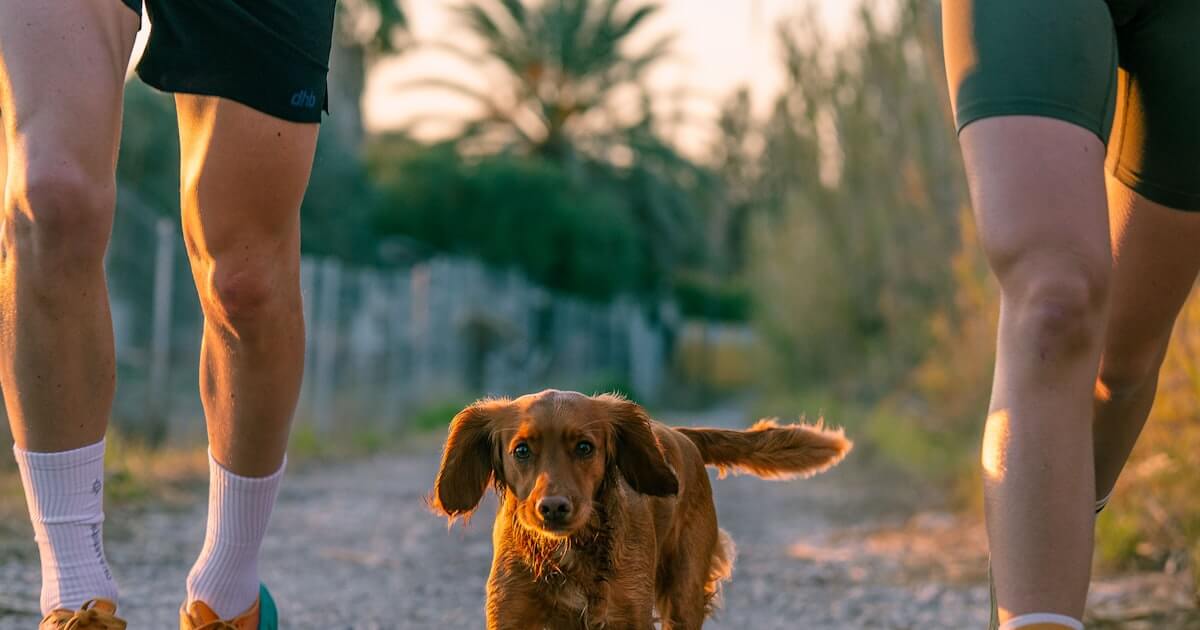
Canicross is the simplest dog sport there is: harness on the dog, belt on your hips, a 2-meter bungee line between you, and you run as a team. It started as off-season training for sled dogs. Now there are 5K and 10K races across Europe and a growing scene in North America. And it comes with a biomechanics puzzle that almost nobody talks about — what happens to your stride when something is towing you.
How much faster does a dog actually make you?
Faster than you'd guess. World canicross champion Ben Robinson runs a 5K in just under 15 minutes on his own. Tethered to his dog Blake, he's run 12:24 — averaging 3:59 per mile pace, quicker than any human has ever covered a solo Parkrun.
You don't need an elite engine to feel the effect. Speed Secrets ran a simple experiment: one runner, one undulating 1.22-mile off-road loop, back-to-back laps. Solo lap: 7:27 at 6:08/mile pace. Second lap with Billy, a spaniel-husky-lab cross, on the line: 6:30, or 5:18/mile. Fifty seconds per mile of dog power.
The mechanism is subtle. As Runner's World describes it, the dog's pull does its work while you're airborne between strides — each flight phase, the line plucks you forward a few extra inches. Small tug, thousands of strides, big time gap.
The catch: your legs become the bottleneck
Here's the part that matters for training. Free forward momentum is useless if your legs can't keep up with it.
A performance study of adult one-dog canicross runners from Northern Michigan University found that race performance correlated significantly with the time athletes spent training without the dog. The human side of the team has to independently develop the ability to increase leg turnover, because the dog will happily set a pace your solo legs have never touched.
Think about what the pull does to your stride geometry. Your stride length increases automatically — you're being carried further through each flight phase. If your cadence stays at your lazy solo baseline, each of those longer strides lands further ahead of your center of mass. That's textbook overstriding: your leading leg becomes a brake, every footstrike fights the dog, and your knees absorb the argument.
The fix is the same one that works for downhill running, which is mechanically a cousin of canicross (in both cases an external force adds speed you didn't generate): keep the turnover high and the stride landing under your hips.
Cadence targets for canicross
Start from your real solo baseline, not from an internet number. Most recreational runners sit at 150–170 SPM at an easy pace, and 160 SPM is perfectly normal. From there:
| Situation | Cadence target | Why |
|---|---|---|
| Solo easy run (baseline) | Your natural 150–170 SPM | Establish this first, over several runs |
| Canicross, steady pull | Baseline +5% | Absorbs the longer flight phase without braking |
| Canicross, hard-pulling dog or race | Baseline +8–10% | Keeps footstrike under your hips at aggressive paces |
| Downhill sections with a pulling dog | Baseline +10%, shorter steps | Double external assist; highest overstride risk |
The 5–10% window isn't arbitrary. Research from the University of Wisconsin published in Medicine & Science in Sports & Exercise found that raising step rate just 5% above preferred meaningfully cuts the mechanical energy absorbed at the knee each stride, and 10% reduces loading at both the knee and hip. You're getting pulled into longer, faster strides; the cadence bump is what keeps that from becoming a joint-loading problem.
If quickening your turnover feels awkward, practice it on solo runs first — here's how to raise cadence without running faster. Do the skill work alone, then bring it to the team.
Match your music to the dog, not to your old playlist
Your usual easy-run playlist is now wrong. If you trained your ears on 160 BPM for solo jogging, your canicross legs need 168–176 BPM, and the old songs will actively drag your turnover back down to the tempo they carry.
This is where canicross gets genuinely awkward: both hands are occupied. One is managing balance against the pull, the other might be holding a poop bag, and the belt means your phone is zipped away somewhere unreachable. Skipping tracks to hunt for the right tempo is not happening mid-run.
A tool like GagaRun solves the specific problem here — it filters your existing playlists down to songs that match your target cadence, so if you set 170 BPM before you clip the line on, everything that plays for the next 40 minutes holds your legs at 170. No screen, no skipping, no negotiating with a dog who wants to go now.
One practical note: set the BPM target before the run. The first kilometer of canicross is chaos (every dog starts too fast and settles later), and the steady beat gives your legs a reference while the dog's pace is still spiky.
Gear and dog-safety basics
Quick but non-negotiable, because bad gear hurts dogs:
- Pulling harness for the dog — never a collar, never a standard walking harness. Collars load the neck; a proper canicross harness lets the dog drive from the chest and shoulders.
- Waist belt for you — sits low on the hips, wide padding, quick-release buckle. Keeps the pull off your lower back.
- Bungee line, about 2 meters — the elastic absorbs surges so neither your spine nor the dog's gets jolted.
- Wait for skeletal maturity. No structured pulling before roughly 12–18 months, depending on breed. Growing joints and repetitive loaded impact don't mix. Ask your vet before starting, and skip runs in hot weather — dogs can't dump heat the way you can.
An 8-week ramp that respects both athletes
- Weeks 1–2: Brisk 20–30 minute walks in full gear. The dog learns the harness means work; you learn the pull.
- Weeks 3–4: Run 2 minutes, walk 2 minutes, 25–30 minutes total. Start voice cues for speed up, slow down, left, right.
- Weeks 5–6: Extend running intervals, add direction changes. Begin your +5% cadence practice on the run segments.
- Weeks 7–8: Continuous 15–20 minute runs, adding 2–3 minutes weekly toward 30. By now the shared rhythm should feel less like being kidnapped and more like a duet.
Frequently asked questions
Does my dog's breed matter for canicross?
Less than you'd think. The American Kennel Club notes that canicross runners compete with everything from Labradors to Mastiffs. What matters is the individual dog's fitness, joint health, and enthusiasm for running — a vet check settles the first two.
How much faster will I run with my dog?
Recreational teams commonly gain 30–60 seconds per mile once dog and runner sync up. The Speed Secrets test measured a 50 sec/mile improvement on a trail loop. Your result depends on the dog's drive, your leg turnover, and how well-practiced the partnership is — an untrained pairing can be slower than running solo.
What cadence should I aim for when the dog is pulling?
Your natural solo cadence plus 5–10%. If you normally run at 162 SPM, target roughly 170–178 SPM under pull. Shorter, quicker steps landing under your hips let you use the dog's momentum instead of braking against it.