
How To Run A Half Marathon Under 1:50: Pace, Splits & Plan
Alex Chen, Certified Running Coach
October 1, 2026
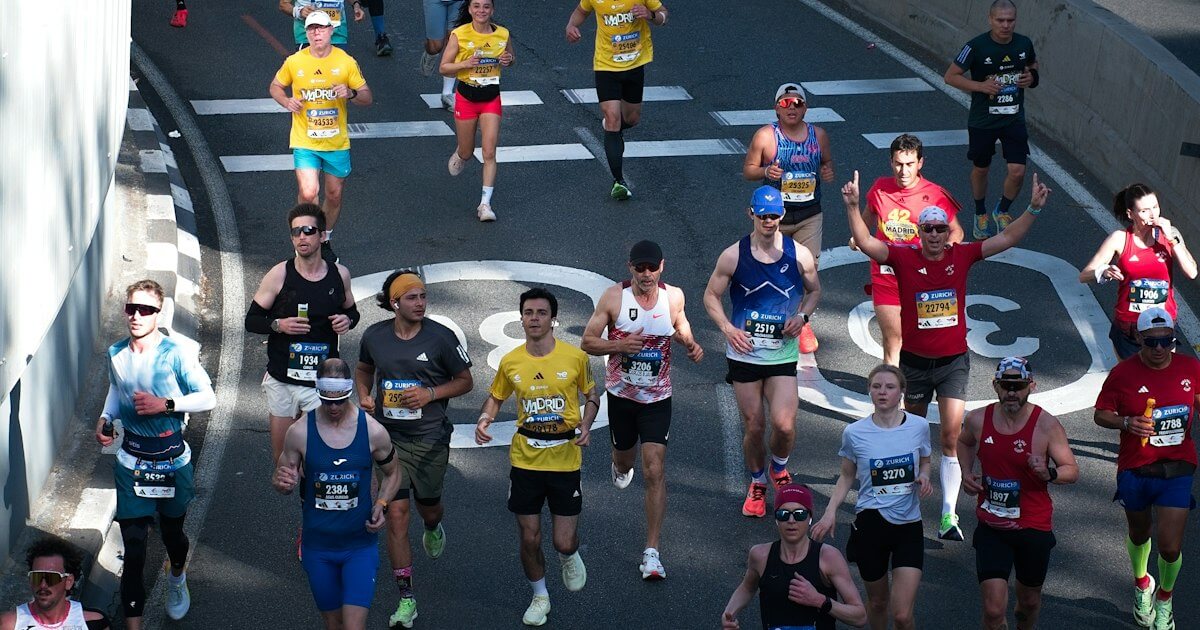
Direct answer: To run a half marathon under 1:50 (13.109 miles / 21.097 km), you must average 8:23.7 per mile (5:12.7 per kilometer). On race day, target an even cruising pace of 8:20 per mile (5:11/km) to cross the finish line in approximately 1:49:15. That 45-second buffer absorbs wide turns, congested water stations, and slight GPS distance inflation. Finishing under 1:50 places you in the top 35% to 40% of all half marathon finishers globally.
Stepping down from a sub-2:00 half marathon to 1:49:59 is the classic transition from completion-focused running to performance-focused pacing. At 9:09 pace, you can afford uneven miles and late slowdowns. At 8:20 pace, you need sustained aerobic efficiency and steady leg turnover. If you drop your cadence when leg fatigue hits at mile 9, your stride lengthens into an energy-sapping brake that puts 1:49 out of reach.
Sub-1:50 half marathon split chart
Targeting 1:49:15 gives you a clean safety margin. If you aim for 1:49:59 on paper, a single windy mile or a crowded water stop can easily leave you at 1:50:15.
| Checkpoint | Target Split (8:20/mi pace) | 1:50:00 Limit (8:23.7/mi) | Metric Split (5:11/km) | Cadence Target |
|---|---|---|---|---|
| 1 Mile / 1.6 km | 8:20 | 8:24 | 8:17 | 168 SPM |
| 5K (3.11 miles) | 25:54 | 26:06 | 25:55 | 168–170 SPM |
| 5 Miles (8.05 km) | 41:40 | 41:59 | 41:42 | 170 SPM |
| 10K (6.21 miles) | 51:46 | 52:09 | 51:50 | 170–172 SPM |
| 15K (9.32 miles) | 1:17:40 | 1:18:14 | 1:17:45 | 170–172 SPM |
| 10 Miles (16.09 km) | 1:23:20 | 1:23:57 | 1:23:24 | 172 SPM |
| 20K (12.43 miles) | 1:43:33 | 1:44:18 | 1:43:40 | 172–174 SPM |
| Finish (13.11 miles) | 1:49:15 | 1:49:59 | 1:49:20 | 174 SPM (Kick) |
Notice the 10K split: 51:46. Running through 6.2 miles around 51:45 feels comfortable when your top-end speed is developed, but exhausting if you surge in the opening miles. For comparative splits across different goal times, review our half marathon pace chart.
3 Fitness benchmarks to test before your build
Before committing to a 1:50 racing goal, verify that your current aerobic capacity matches the distance demands. Based on Jack Daniels' VDOT tables, a 1:50:00 half marathon equates to a VDOT score of approximately 40.5 to 41.0:
- A sub-24:00 5K (approx 7:43/mile or 4:48/km). You need enough top-end speed reserve so that 8:20 pace feels conversational during the first half of the race. If your 5K is over 25 minutes, run a 4-week turnover block using our sub-25 5K plan before starting half marathon preparation.
- A sub-50:00 10K (approx 8:03/mile or 5:00/km). This is the strongest single indicator. If you cannot hold 8:03 pace for 6.2 miles, sustaining 8:20 for 13.1 miles is unrealistic. If your 10K is currently 52 to 54 minutes, work through our sub-50 10K guide first.
- Consistent weekly volume of 24 to 34 miles (38 to 55 km). Running 13.1 miles at 8:20 pace requires absorbing over 14,000 footstrikes. Without a regular base of at least 24 miles per week across 6 to 8 weeks, connective tissue breaks down in the final 5 kilometers.
To see where this sits relative to other runners in your age bracket, check our average half marathon time by age chart.
Biomechanics: Why step rate controls mile 10
Runners rarely miss a 1:50 goal because of sudden lung failure. They miss it because of cadence decay.
At an 8:20/mile pace (11.6 km/h), most efficient runners maintain a cadence of 168 to 174 steps per minute (SPM). A landmark biomechanical study published in Medicine & Science in Sports & Exercise (Heiderscheit et al., 2011) showed that increasing running step rate by 5% to 10% brings the foot strike closer to the runner's center of mass, shortens ground contact time, and substantially lowers mechanical loading at the knee and hip joints.
Mile 3:  Cadence 170 SPM | Foot lands under hips   | Elastic return | Pace 8:20
Mile 10: Cadence 158 SPM | Foot overstrides ahead  | Braking spike  | Pace drops to 8:55
When fatigue accumulates past mile 9, the nervous system naturally slows stride turnover to conserve muscular effort. If you try to hold 8:20 pace while your cadence drops from 170 down to 158 SPM, your stride length has to jump from 1.14 meters to 1.23 meters. Your heel strikes out in front of your knee, sending an impact shockwave up your tibia and acting like a brake on every stride. Your pace drops 30 seconds per mile even as your heart rate stays high.
Lock your 8:20 pace with 168–174 BPM playlists
Checking a GPS watch every 400 meters creates erratic pacing and wastes mental energy. Synchronizing your footfalls to music tempo creates an external rhythm anchor that protects your turnover.
Sports science research published in the Journal of Science and Medicine in Sport (Terry et al., 2012) found that running in sync with a rhythmic beat reduced oxygen consumption by 1% to 2% and extended time to exhaustion by up to 18% compared to running without music.
Here is how to structure your race day tempo:
- Miles 1 to 3 (The speed restrictor): 168 BPM. Adrenaline pushes everyone to sprint off the start line. A 168 BPM track prevents you from running a disastrous 7:45 opening mile. Settle in and cross 3 miles right around 25:00.
- Miles 4 to 9 (The cruise lock): 170–172 BPM. Settle into your aerobic rhythm. Let your feet strike on every beat. At 8:20 pace, 170 SPM gives you a compact, repeatable stride that preserves glycogen.
- Miles 10 to 13.1 (The turnover defense): 172–174 BPM. When your calves and glutes tighten, switch to 174 BPM. A slightly faster tempo forces your turnover to remain quick. Even if your stride length shrinks by an inch from fatigue, 174 steps per minute holds your pace right at 8:20.

Manually shuffling through playlists on Spotify or Apple Music mid-race is frustrating and ruins your focus. A specialized tool like GagaRun scans your music library and automatically plays only tracks that match your selected BPM range. Set it to 170 BPM during the mid-race miles and 174 BPM for the closing stretch, and your footstrikes remain locked to your target rhythm without touching your phone.
The 8-week sub-1:50 training framework
This 8-week block assumes you already run 20 to 25 miles per week and can complete an easy 8-mile long run.
The 3 mandatory weekly workouts
- Threshold Tempo Run (Tuesday): 2 miles warmup, 4 to 5 miles continuous at 8:05 to 8:10/mile (5:01–5:04/km), 1 mile cooldown. This raises your lactate threshold velocity so that 8:20 pace feels sustainable for two hours.
- Speed & Turnover Intervals (Thursday): 5 to 6 repeats of 1,000 meters at 7:40/mile (4:46/km) with 90 seconds of jogging recovery. This builds aerobic power (VO2 max) and reinforces rapid leg turnover under fatigue.
- Progressive Long Run (Saturday or Sunday): 10 to 13 miles. Run the first two-thirds at comfortable conversational pace (9:30 to 10:00/mile), then drop the final 2 to 3 miles down to race pace (8:20/mile).
Fill the remaining 1 or 2 running days with easy conversational recovery miles (9:45–10:30/mile) to keep weekly mileage between 28 and 34 miles.
Key milestone workouts
- Week 4 Checkpoint: 6 miles continuous at goal pace (8:20/mile). If your average heart rate stays below 85% of your maximum throughout, your aerobic engine is tracking on schedule.
- Week 6 Peak Long Run: 13 miles total, structured as 10 miles easy (9:45/mi) followed immediately by 3 miles at 8:15/mi. This proves your legs can turn over at race pace while low on glycogen.
- Week 8 Race Week: Cut volume by 50%. Run a 3-mile shakeout on Thursday with 4 x 100m strides at 174 BPM, rest on Friday and Saturday, and execute your pacing splits on Sunday.
Once you have mastered the 1:50 mark, you can begin targeting a sub-1:45 half marathon in your subsequent racing cycle.
Race day nutrition and fueling protocol
At 8:20 pace, you are on the course for 110 minutes. Your body burns roughly 1,300 to 1,500 total calories, with roughly 65% to 75% derived from muscle glycogen.
- Pre-race breakfast: Consume 60 to 80 grams of simple carbohydrates (such as oatmeal with honey or white toast with banana) 2.5 to 3 hours before the gun.
- Hydration: Sip 300 to 400 ml of water or electrolyte drink up to 45 minutes before the start. Stop drinking 30 minutes before to empty your bladder.
- In-race carbohydrates: Take one energy gel (20 to 25 grams of carbs) at mile 4 (approx 33 minutes) and a second gel at mile 8 (approx 66 minutes), always washed down with 2 to 3 ounces of plain water from an aid station. Do not wait until mile 10 to take your first gel; glycogen absorption takes 10 to 15 minutes.
Frequently asked questions
Is a 1:50 half marathon considered good?
Yes. A 1:50:00 finish places you well above average, landing inside the top 35% to 40% of all half marathon participants worldwide. For men, the global median finish time sits around 1:55 to 2:02. For women, the global median sits around 2:10 to 2:16.
What pace is needed for a 1:50 half marathon in kilometers?
You need an average pace of 5 minutes and 12.7 seconds per kilometer (5:13/km). To ensure you finish under 1:50 on courses with wide turns and GPS inaccuracies, target 5:10 to 5:11/km on your watch.
What should I do if my natural cadence is 160 SPM?
Do not attempt to jump straight from 160 to 174 SPM in a single week. Sudden increases place excessive load on the calves and Achilles tendons. Instead, follow the 5% rule: start your easy runs at 165 BPM for two weeks, progress to 168 BPM, and gradually build toward 172 BPM over the course of your 8-week training block.





