Arc Trainer Workout Guide: Best SPM And Music BPM Settings
Mia Taylor, Music & Workout Curator
July 27, 2026
TL;DR: For steady-state cardio on the Arc Trainer, hold 100-120 strides per minute (SPM). For intervals, push work sets to 120-140 SPM and recover at 60-80 SPM. Music matching is simple: pick songs at the same BPM as your target stride rate, or use half-time (one stride per two beats) with 120-140 BPM tracks when you're grinding a heavy, slow climb.
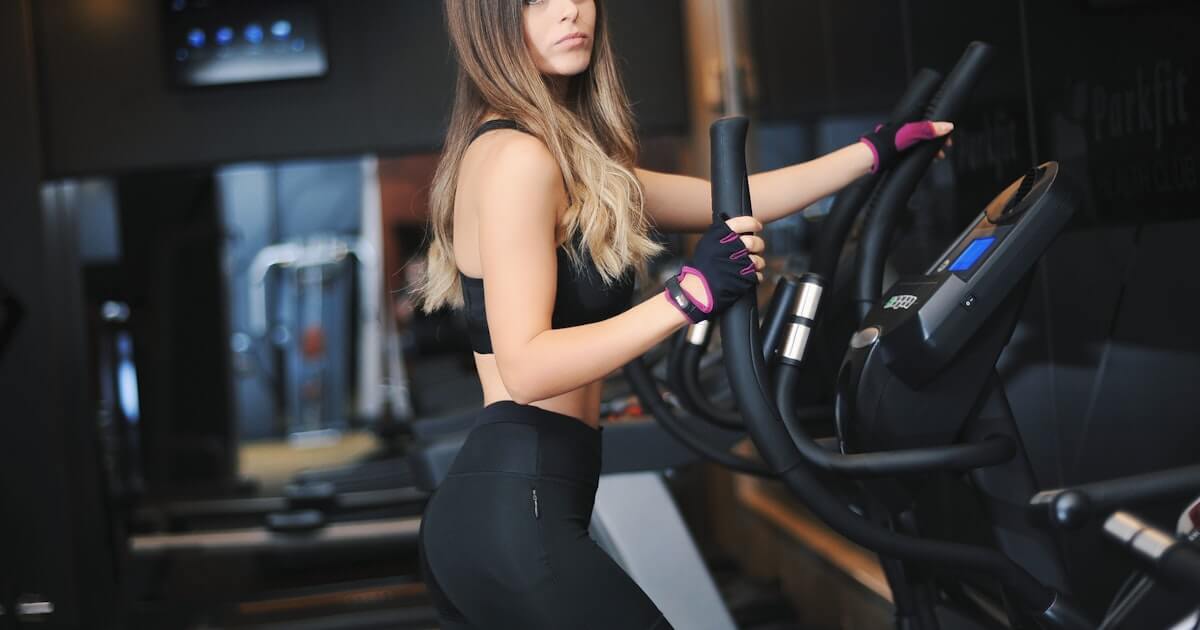
The Arc Trainer is the machine most people walk past. It looks like an elliptical that got into a fight with a stair climber, and the console asks you to set three separate things: incline, resistance, and stride rate. That third one is where music comes in, and it's the one almost nobody manages on purpose.
What is an Arc Trainer, actually?
An Arc Trainer is a non-impact cardio machine made by Cybex. Instead of the flat oval path your feet trace on an elliptical, the footplates travel along an arc. The design loads your legs only during the weight-bearing phase of your stride, which spreads the work between the hip and knee instead of dumping it on the knee.
The incline setting changes what the machine imitates:
| Incline range | Feels like | Main muscles |
|---|---|---|
| Low (0-3) | Cross-country ski glide | Quads, hip flexors |
| Middle (4-7) | Elliptical stride | Quads, glutes, hamstrings |
| High (8+) | Stair climbing | Glutes, hamstrings, calves |
One machine, three movement patterns. Which is also why nobody can tell you the single "correct" stride rate: a level 2 glide and a level 9 climb are different workouts with different rhythms.
Does it really burn more calories than an elliptical?
You'll see a "16% more calories than an elliptical" claim on Cybex marketing. Worth knowing where it comes from: research cited on the Arc Trainer's Wikipedia entry found healthy men burned about 10.8 calories per minute on the Arc versus 9.3 on an elliptical, and a 2010 study by Turner and colleagues in the Journal of Strength & Conditioning Research compared physiological responses across machines. But the 16% figure traces back to manufacturer-partnered research that never went through peer review, so treat it as a plausible edge, not a settled fact.
Here's the honest version: calorie burn depends mostly on how hard and how long you work, not which machine you stand on. The Arc's real advantage is that its resistance curve makes it hard to coast. On an elliptical you can zone out and let momentum carry you. On the Arc, the load keeps asking for actual effort, which is exactly why a rhythm anchor helps so much.
Your SPM targets by workout type
Life Fitness (which owns Cybex) publishes Arc Trainer programs, and they're consistent about stride rate:
| Workout | Stride rate | Incline | Resistance approach |
|---|---|---|---|
| Warm-up | 100-110 SPM | 3-8 | Light (15-30) |
| Steady-state / Zone 2 | 100-120 SPM | 4-6 | Moderate, hold 20-40 min |
| Interval work sets | 120 SPM | 5-8 | Increase +5 each set |
| Advanced HIIT | 120-140 SPM | 8 | As high as you can hold |
| Recovery between sets | 60-80 SPM | Same | Same, just slow down |
The signature Arc Trainer progression works like this: keep your stride rate pinned at 120 SPM and raise the resistance every interval until you can't hold the pace. Recreational runners often work up to resistance 50-60 doing this. The stride rate is the constant; resistance is the variable. Which means if your stride rate wanders, the whole progression falls apart.
Matching music BPM to your stride rate
This is the part that turns a decent Arc session into one you actually finish. Your stride rate on this machine is self-selected, and self-selected tempo drifts. Ten minutes in, 120 SPM quietly becomes 108 and you never notice because the console number is small and you're busy suffering.
Music fixes the drift, because your feet will follow a beat long after your attention has wandered. Three ways to match:
- Direct match (100-140 SPM range). One stride per beat. A 120 SPM steady-state session wants 120 BPM songs. This range is a gift, honestly: 100-130 BPM is where a huge share of pop, funk, and classic house lives, so you have more song choices here than runners chasing 170+ BPM ever get.
- Half-time for heavy climbs (50-70 SPM). High incline plus high resistance drops your stride rate way down, the same way it does on a StairMaster. There is no motivating music at 60 BPM. Use 120-140 BPM tracks and take one stride every two beats. Same trick we recommend for the StairMaster's slow step rates.
- Interval playlists. Alternate song tempos with your work/rest structure: 130 BPM tracks for 3-minute work sets, 100 BPM for the 1-minute recoveries. Your legs get the tempo change cue before your brain does.
Manually building those playlists means checking the BPM of every song. A tool like GagaRun skips that step: it reads your stride rate and filters your existing Apple Music or Spotify library to songs matching your target SPM, so a 120-strides-per-minute set stays at 120 without you staring at the console.
A 30-minute Arc Trainer interval workout
- Warm up, 5 minutes. Incline 5, resistance 20, ride at 105 SPM with a ~105 BPM song.
- Work set, 3 minutes. Hold 120 SPM at resistance 25. Music at 120 BPM, one stride per beat.
- Recover, 1 minute. Slow to 70-80 SPM. Keep incline and resistance where they are.
- Repeat the 3-on/1-off cycle, adding 5 resistance each work set, until you can't hold 120 SPM. Then drop resistance back 5 and finish out the 30 minutes.
- Cool down, 3-5 minutes. Incline 3, light resistance, 90-100 SPM.
If you can talk in full sentences during work sets, the resistance is too light. If your stride rate falls off the beat before the 3 minutes end, it's too heavy.
Common mistakes
Hanging your torso on the rails. Cybex's own testing found arm position alone shifts calorie burn by 6-8%. Active use of the moving handles is fine. Locking your elbows and dumping your bodyweight onto the static rails is not; it turns a climb into a supported shuffle.
Copying elliptical settings. The Arc's resistance scale is proportional to body weight and runs much higher than most ellipticals. Resistance 40 here is not resistance 40 there. Start lower than your ego suggests. (If you're deciding between the two machines, our elliptical BPM guide covers that side.)
Chasing stride rate instead of resistance. Spinning at 150 SPM on resistance 10 feels fast and burns little. The machine rewards force. Lock the tempo at 120, push the load.
Frequently asked questions
What SPM should a beginner use on the Arc Trainer?
Start at 100-110 SPM with incline 4-5 and light resistance (15-25) for 20 minutes. Pick 100-110 BPM music to hold it steady. Add resistance week by week before you ever add stride rate.
Is the Arc Trainer good for bad knees?
It's one of the more knee-friendly cardio machines because the arc path loads the leg mainly during weight-bearing and shares work between hip and knee. Zero impact, unlike a treadmill. If a specific knee condition is the concern, a physical therapist beats a blog post.
Arc Trainer or StairMaster for glutes?
High-incline Arc work (8+) and the StairMaster hit similar territory. The Arc lets you add resistance beyond body weight, which the StairMaster can't; the StairMaster forces you to lift your full body weight every step. Rotating both is a reasonable answer. Our StairMaster playlist guide covers pacing on that side.
What BPM music works for the Arc Trainer?
For most sessions, 100-130 BPM matched one-stride-per-beat. For slow, heavy climbing at 50-70 SPM, use 120-140 BPM tracks in half-time, one stride every two beats.